PLTS resources created through fabulous collaboration

(Taken from an original post on a PLTS Action Research Blog)

These resources are under development with the PLTS team at the moment….it goes something like this…

(1) Have an idea

(2) Ask, “I wonder if…?” within earshot of team members

(3) Prototype gets developed

(4) Prototype is tested and refined both in terms of its design and its application to task

(5) Prototype becomes a real resource

We are a great team!

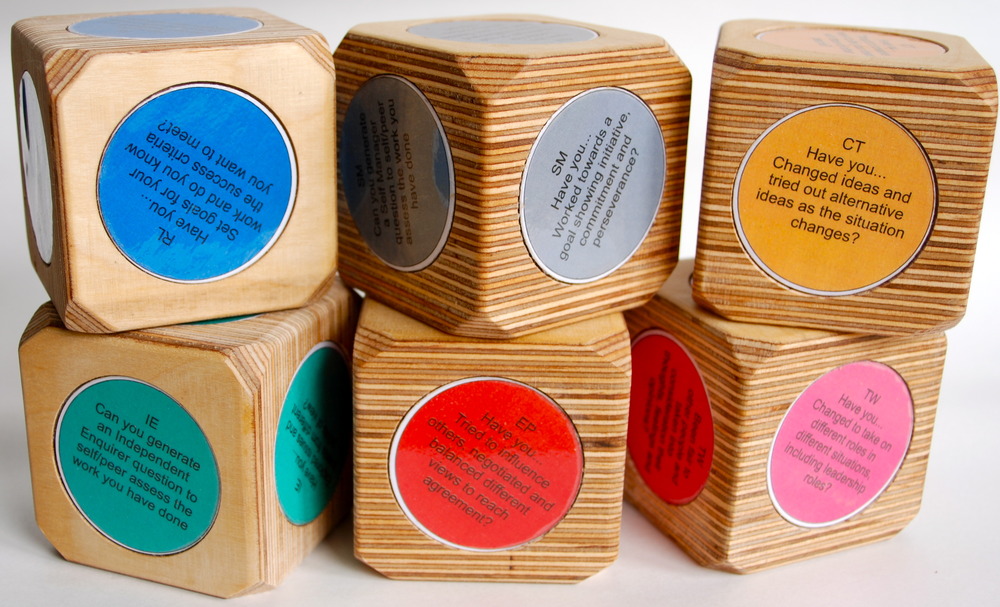
The resources are designed to stimulate QUALITY LEARNING CONVERSATIONS, using the language and concepts of the PLTS. We’ll let you know how are ‘field trials’ go.

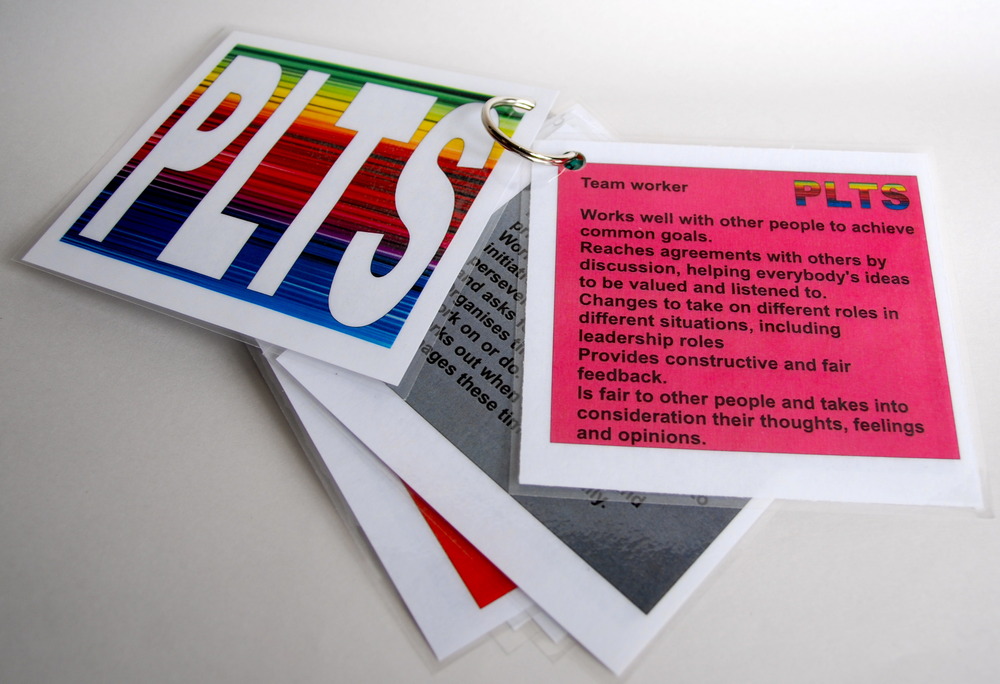
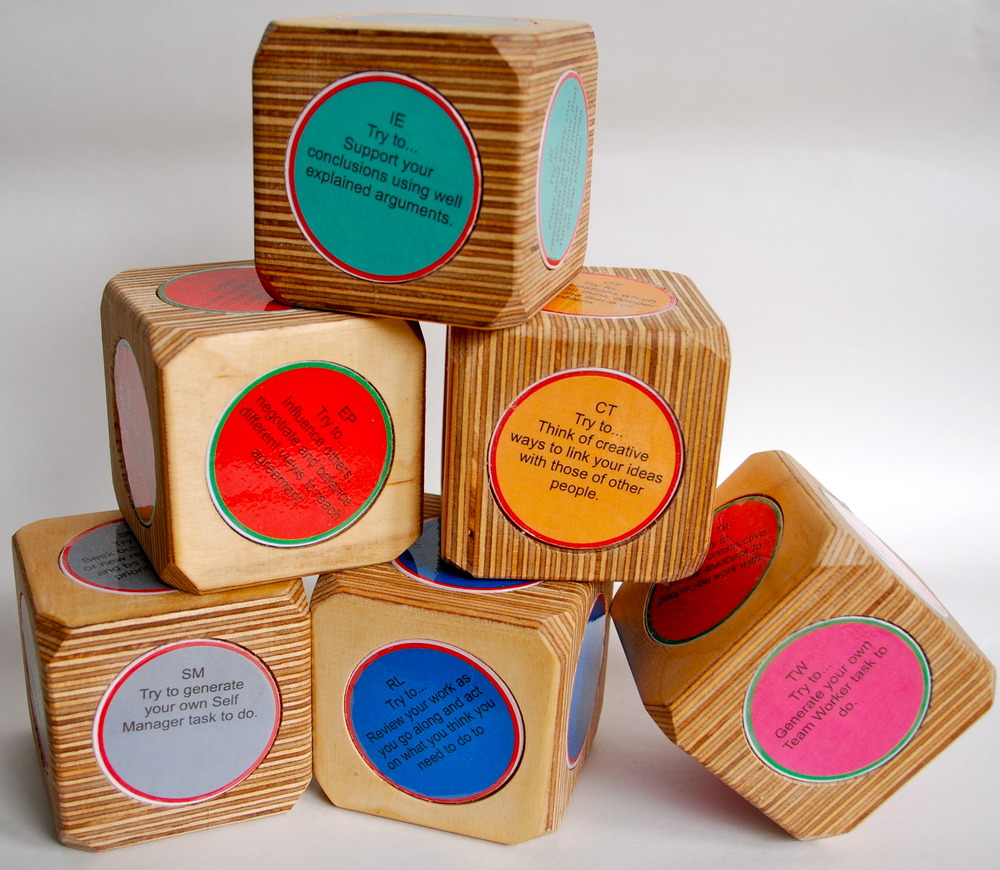
The dice are designed as one per PLTS, in two versions, one set is to be used reflectively with the prompt of ‘Have you…’ and the other set is to set PLTS targets ‘Try to…’. They are made out of wood and are, in themselves, things of beauty! The swatch cards are for teachers to refer to when they are observing learning, to support the integration of PLTS language and the cards are for learners to use to reflect and develop the PLTS as a shared language for learning. We’ll be road-testing them all with our project teams of Confident Communicators on Thursday, when we’re holding the Presentation Day for the project. The day is being run alongside an LA AfL teacher conference, and the teachers will attend some of the presentations as a CPD workshop to have a go at observing the PLTS in action using ‘Observing Learning’ techniques we’re developing.

Dsc_0023
Dsc_0024
Dsc_0025
Dsc_0026
Dsc_0027

G&T and PLTS – an integrated approach

I’ve put this together in response to a really good question, “How do we ensure challenge for our most able in a competency-based curriculum?”. A similar question that was posed to me when I gave a presentation to a regional group of English Local Authority Advisers.

I was explaining the potential of PLTS to support the development of gifts and talents using, as a case study, my work with a G&T Lead School to develop G&T provision through the Personal Learning Thinking Skills. This approach is working really well for the school, not least because it has prompted some in-depth discussion. They have been able to explore the tension between emphasising knowledge, subject expertise and generic learning skills in constructing learning opportunities. The group to whom I was speaking had similar reservations and were very concerned that in using the PLTS as the basis for identifying high ability in English, the distinctive subject expertise might be lost. I was able to reassure the group (I hope) that by using the PLTS as a start point and then linking this to subject-specific characteristics of high ability, identification of and provision for the most able would be far more complete. Following this discussion, I started to put together my thinking and came up with the following document (below).

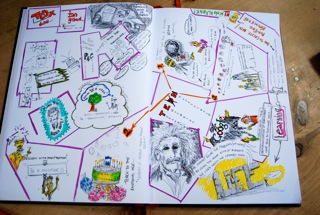
Please have a read of the document (click in the centre for full screen) and I’d be very interested to hear your comments. I’m also keen to hear about what you are doing in your schools. You’ll see a reappearance of my underground maps and you’ll also see some of the practical activities I use in the classroom to create challenge. I will also post this entry on our PLTS Action Research Network blog, which is password protected at the moment, but we’ll open it up if there’s enough demand.
 
The meta-menus featured in this document are from the FABULOUS G&T Pocketbook by Barry Hymer – I HIGHLY recommend getting yourself a copy of this little gem of a book!
 
Much of the content in this document which will be featured in my book…consider this a teaser…!
 

“RESEARCH WEEK” for Confident Communicators

Since the launch of the Confident Communicators’ project (see previous post on February 24th), I have been reflecting on the PLTS that the students are developing throughout this long-term project and it is abundantly clear that of ALL the PLTS, the skill of being an EFFECTIVE PARTICIPANT is the singular learning skill in the spotlight. What will be interesting to reflect upon, however, will be the learning DISPOSITIONS necessary for learners to develop. Key questions we need to ask when we are observing the learning of the students need to be focused on the learning behaviours that students are displaying that allow the project move forward.

All of the teams are having their learning journeys documented by the AST team, using enhanced This involves the teams taking photographs of key moments of their project work and the ASTs undertaking interviews with the students to unpack how the process is helping them learn. The early edits of these are already flagging up the ‘make-or-break’ elements of the challenge for the teams being hinged upon the EFFECTIVE PARTICIPATION of the team members. They mention their need to communicate effectively with each other and those who can help them with their research. They also talk about listening to each other, organising their thoughts and ideas and really working together as a research group to make sure they make the necessary progress.

All the teams are off to The Pervasive Media Studio (www.pmstudio.co.uk) in Bristol next week. This is a structured research visit that we have set up for them to support their research and give them an experience of field research and hands-on learning. We’ll have lots to report about this particular experience by the end of the week.

The Power of Twitter (ONCE AGAIN)

Thanks to Jamie Portman for his cracking endorsement of the power of Twitter found here: http://www.jamieportman.com/blog.

Jamie has been part of my personal learning network for a long time now. I’ve been through the lurking stage with him right through to mentions, DMs and emails to share resources with him (which reminds me that I have some more for him I MUST send – sorry for the delay, Jamie!). Next, I really hope I’m going to be able to visit and see the amazing work of Jamie, his staff and students since a fire ripped through the school buildings at Campsmount, Doncaster in December last year.

Please do follow Jamie on Twitter @jamieportman – he’s got some great follows and followers and is leading some very innovative, pragmatic learning in his school.

The real power of Twitter is all that I’ve said, but It’s also enough to bring me out of my self-enforced silence during my holiday in an attempt to SWITCH OFF. I try really hard to relax and clear my head when I take time off but to be honest, it doesn’t really work.
Just today I have been reading “Over-schooled but Under-educated” by John Abbott. I continue to lurk on Twitter during my ‘silent holiday’ (I’m not supposed to be interacting in this ‘switch-off’ mode) and this afternoon, I have researched a number of educational readings…I’m currently checking out a range of different teaching models including the Autonomous Learner Model and the Cognitive Apprenticeship Model (http://www.edtech.vt.edu/edtech/id/models/cog.html) with which I’m undertaking some action research in our ‘Confident Communicators’ Project’ (see previous post) at the moment and will be talking about at a number of conferences in the next few months.
I’ve also done some work on my book plus I’ve downloaded Dan Pink’s talk at the RSA (www.thersa.org), which has been added to the RSA Animate series – check it out if you’re interested in finding out about intrinsic motivation, with some powerful scientific evidence to support the case…it brilliantly enriches the TED talk (www.TED.com) he gives around the same issues.

I also went on a four mile walk this morning along Monmouth Beach, Lyme Regis and saw some spectacular fossils and the other side of the day involved a final circuit of the harbour and the Cobb. ‘Switching off’, it would seem, is very subjective…

Creative collaboration

Over the past 18 months, I have been involved in one of the most powerful projects in my career to date. At first glance, the role of facilitating a group of educators as they explore questions related to creative learning may not appear so very innovative. On closer inspection, however, any enquiring eye will discover a powerful and very real example of teachers and teaching assistants collaborating to build a purposeful and safe learning community. The result of which is having a powerful and sustainable impact on learning opportunities for children and on the professional confidence of all the adults involved.

I have learnt so much about the importance and value of investing time and space to provide quality regular opportunities for educators to reflect on, develop and evaluate their practice. At times it has felt so slow in comparison to the frenetic nature of everyday school life that I have worried that we’re not achieving anything. I have been acutely aware of my responsibility to demonstrate concrete outcomes (the production of ‘stuff’) in order to justify teachers’ time out of the classroom and away from their classes, but I haven’t known what ‘stuff’ we could present. Instead, I have focused relentlessly on documenting the conversations, discussions and reflections of the group members. I have subjected them all to their own documentations including writing, video and digital photography and insisted that they provide their own sources of evidence of impact throughout the meetings. They have kept their own learning logs, recording ideas they pick up from each other and things they have tried with their own classes and other colleagues back in school. I have set homework for them and required them to take a ‘Creativity Pledge’ at each meeting to state what they had done, the impact of this, their next steps and some possible outcomes. It has been rigorous for all involved, but this approach has, without doubt, sustained a purposeful, thoughtful and very very safe learning community.

I hope that the findings that the research group produce provide a way forward for all schools to support innovative developments in teaching and learning and take 21st century learning by the scruff of the neck once and for all. This is an 18 month snapshot and there will, I know, be much, much more to follow…

I {heart} Futurelab

This is a great thought-piece that we will be using for our ‘Confident Communicators’ Project. The teams of Year 8 students have been challenged to research the future and this film will help stimulate their thinking and discussions. Thank you, Futurelab! I highly recommend their work – why not make yourself a cup of tea and set aside a chunk of time to explore their work if you haven’t been there before OR been there for a while.

IDEO Education Animated Films: Living Climate Change

So now I’ve explored the IDEO Living Climate Change site (www.livingclimatechange.com) a little more and found the education section. Here are a couple of great animated films that could be used to stimulate thinking and discussion about the lives we live now and the possible futures we could have. I personally love the idea of having a curriculum subject called, “Consequences” (referred to in the second film, “A Little Brighter”). Much more to explore…

A little dimmer

A Little Bit Dimmer from IDEO on Vimeo.

A little brighter

A Little Bit Brighter from IDEO on Vimeo.

IDEO imagine the future of play

I love the way IDEO think. Some of their projects have clear opportunities with which educators can connect. More importantly, the questions that IDEO raise and use to inform their thinking are incredibly powerful. I’m involved in a ‘Future Researcher’ project with Year 8 students at the moment. I wonder how they would use this and the films that IDEO say are yet to come in their projects….

(From the IDEO website www.ideo.com)

As part of Living Climate Change, IDEO imagines a future shaped by electric power dependency – where schoolyard play offsets the cost of fossil fuel and kids take an active part in their powering their world. Tune into IDEO next week, when we’ll envision a brighter future. For more scenarios, click through to Living Climate Change, a place to discuss the most defining design challenge of our time.

<p>Escape from IDEO on Vimeo.</p>