Futurelab & Education Eye goes live!
A great resource for all educators…check it out at http://www.educationeye.org.uk/ …you may even see www.fullonlearning.com featured!!

Futurelab & Education Eye goes live!
I love this – about 3 minutes of insight…simple but very effective explanation of how to start a movement…OR…what is really the truth behind effective leadership.
The latest TED Talk from Charles Leadbeater. Make yourself a cup and sit and listen to this for 18 minutes.
Makes you think.The issue for me at the moment is to support schools in their endeavours to make learning skills explicit within the context of learning delivered. Basically, where I’ve got to with the whole skills versus knowledge debate is that I don’t think think that there is a need for us to talk about ‘skills’ OR ‘knowledge’ as we clearly need both. Developing skills for learning requires a context with purpose. Effective learners have both subject (domain) expertise AND skills to enable them to deepen their knowledge and understanding. In addition, they also have the appropriate dispositions that enable them to learn effectively with their peers. This boils down to three essential planning questions…
1. What do I need to know? (knowledge and understanding)
2. What do I need to be able to do? (learning skills)
3. What do I need to be like? (dispositions)
A most excellent colleague gave me this analogy today…”…think about Stephen Spielberg. He has fantastic subject (domain) expertise when it comes to film-making, and he certainly has some superb generic skills around problem solving, creative thinking, analysis and so on. He also has dispositions such as the openness to new ideas, empathy with others and the understanding of human emotions that enable him to employ his generic skills appropriately within his specialised domain. But take him out of his specialist domain of film-making to problem solve the global deficit and he would be a novice, with absolutely no certainty of success.”
New context requires new KNOWLEDGE. The skills and dispositions are, in many instances, generic, but it is the subject or domain knowledge that is critical to the development of expertise.
We need it all.
When I work with teachers all over the country I am able to consolidate my thinking around these issues and the last two weeks have been particularly valuable for me. I spoke in Malvern at a conference about this, with particular reference to the development of expertise (gifts & talents) within a competency-based curriculum and it really helped move my thinking forward. I then visited a fantastic school in Leeds to see the Critical Skills Programme in action and coming up is a presentation at the Curriculum Foundation Conference in Birmingham. I’m hoping that by the end of this next week…
I’ll have my arguments thoroughly sorted. In the meantime, here’s the resource that I put together for the Malvern event. It’s the next step on from the last resource I put together and I am already developing the third version with a greater emphasis on dispositions. If you click on the centre of the booklet, you’ll get it in fullscreen. If you do find this useful (or not, for that matter), I’d love to hear your thoughts, so please comment or tweet me.
(Taken from an original post on a PLTS Action Research Blog)
These resources are under development with the PLTS team at the moment….it goes something like this…
(1) Have an idea
(2) Ask, “I wonder if…?” within earshot of team members
(3) Prototype gets developed
(4) Prototype is tested and refined both in terms of its design and its application to task
(5) Prototype becomes a real resource
We are a great team!
The resources are designed to stimulate QUALITY LEARNING CONVERSATIONS, using the language and concepts of the PLTS. We’ll let you know how are ‘field trials’ go.
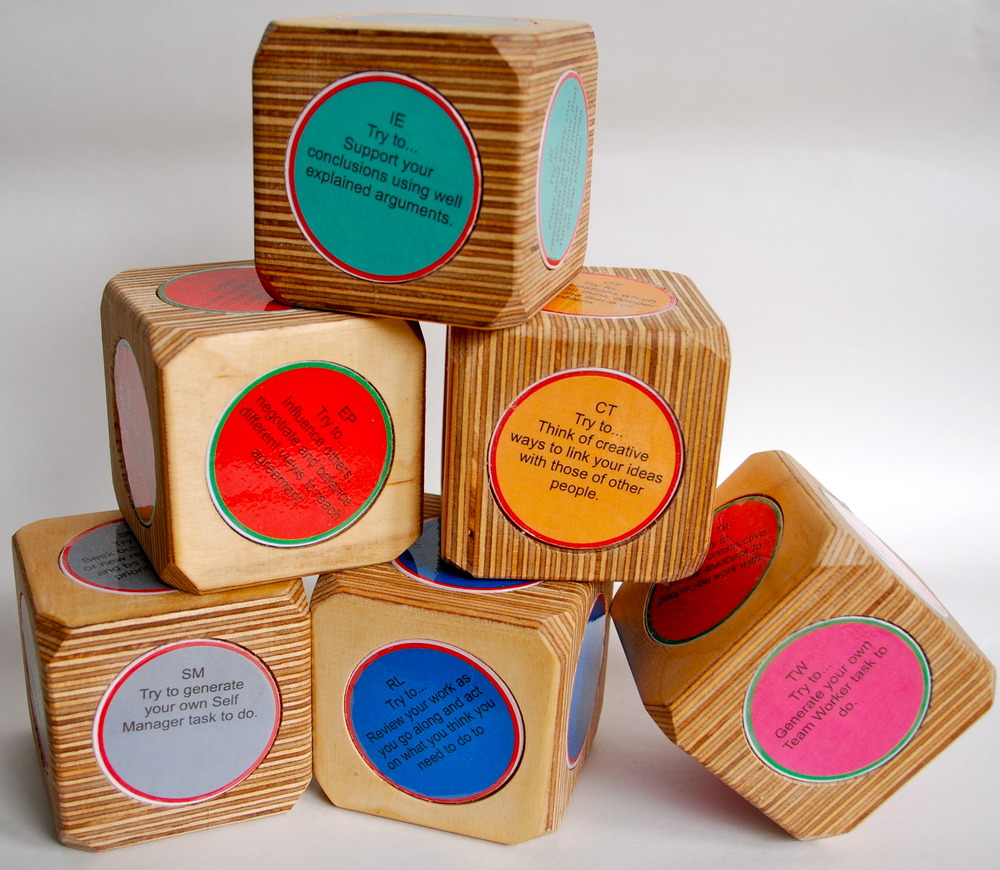
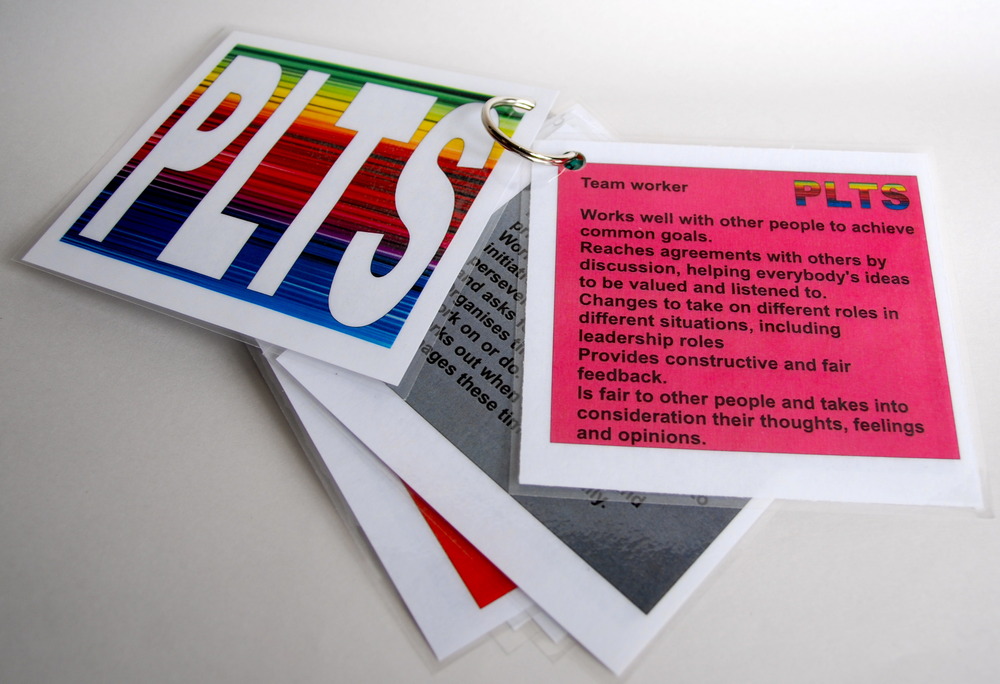
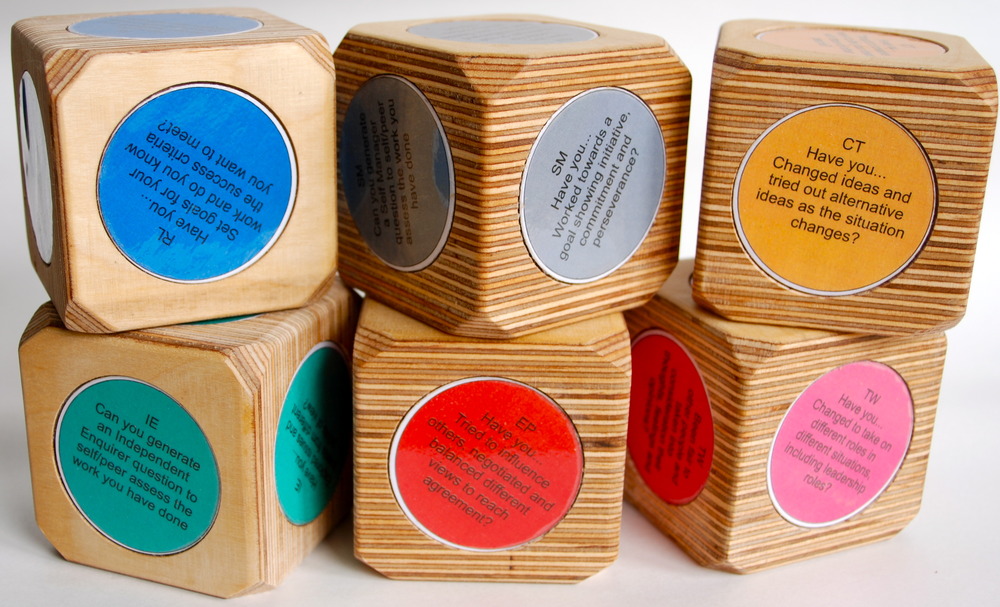
The dice are designed as one per PLTS, in two versions, one set is to be used reflectively with the prompt of ‘Have you…’ and the other set is to set PLTS targets ‘Try to…’. They are made out of wood and are, in themselves, things of beauty! The swatch cards are for teachers to refer to when they are observing learning, to support the integration of PLTS language and the cards are for learners to use to reflect and develop the PLTS as a shared language for learning. We’ll be road-testing them all with our project teams of Confident Communicators on Thursday, when we’re holding the Presentation Day for the project. The day is being run alongside an LA AfL teacher conference, and the teachers will attend some of the presentations as a CPD workshop to have a go at observing the PLTS in action using ‘Observing Learning’ techniques we’re developing.


I’ve put this together in response to a really good question, “How do we ensure challenge for our most able in a competency-based curriculum?”. A similar question that was posed to me when I gave a presentation to a regional group of English Local Authority Advisers.
I was explaining the potential of PLTS to support the development of gifts and talents using, as a case study, my work with a G&T Lead School to develop G&T provision through the Personal Learning Thinking Skills. This approach is working really well for the school, not least because it has prompted some in-depth discussion. They have been able to explore the tension between emphasising knowledge, subject expertise and generic learning skills in constructing learning opportunities. The group to whom I was speaking had similar reservations and were very concerned that in using the PLTS as the basis for identifying high ability in English, the distinctive subject expertise might be lost. I was able to reassure the group (I hope) that by using the PLTS as a start point and then linking this to subject-specific characteristics of high ability, identification of and provision for the most able would be far more complete. Following this discussion, I started to put together my thinking and came up with the following document (below).
Just found this via my ISSUU site. Interesting summary, I think and something I can around which I will build some learning opportunities.
Since the launch of the Confident Communicators’ project (see previous post on February 24th), I have been reflecting on the PLTS that the students are developing throughout this long-term project and it is abundantly clear that of ALL the PLTS, the skill of being an EFFECTIVE PARTICIPANT is the singular learning skill in the spotlight. What will be interesting to reflect upon, however, will be the learning DISPOSITIONS necessary for learners to develop. Key questions we need to ask when we are observing the learning of the students need to be focused on the learning behaviours that students are displaying that allow the project move forward.
All of the teams are having their learning journeys documented by the AST team, using enhanced This involves the teams taking photographs of key moments of their project work and the ASTs undertaking interviews with the students to unpack how the process is helping them learn. The early edits of these are already flagging up the ‘make-or-break’ elements of the challenge for the teams being hinged upon the EFFECTIVE PARTICIPATION of the team members. They mention their need to communicate effectively with each other and those who can help them with their research. They also talk about listening to each other, organising their thoughts and ideas and really working together as a research group to make sure they make the necessary progress.
All the teams are off to The Pervasive Media Studio (www.pmstudio.co.uk) in Bristol next week. This is a structured research visit that we have set up for them to support their research and give them an experience of field research and hands-on learning. We’ll have lots to report about this particular experience by the end of the week.
Inspired by a number of visual diagrams using the iconic London Underground Tube map, I’ve been working on a way to demonstrate the way in which Personal Learning Thinking Skills can have a significant impact on the quality and rigour of learning for all students.
I’ve taken a more traditionally designed linear model of a collaborative project that I used to teach at Key Stage 3 and re-designed it using the PLTS as a start point.
Instead of asking, ‘What do I want the students to know about and understand?’, I asked ‘What sort of learners need to develop as a result of learning about this topic…what do they need to be able to do and what do they need to be like?’. I then asked, ‘What explicit learning opportunities can I design to enable this to happen?’. I then ended up planning how students can ACCESS relevant knowledge so that they can create their own understandings, together.
I also considered what skills and dispositions they needed to have and what specific opportunities I needed to build into the learning journey to ensure that this could happen.
My learning objectives changed radically as a result…
I immediately moved away from learning objectives that were all about to knowledge acquisition towards those skills that were far more closely linked to the underlying reason why I designed this as a piece of collaborative learning in the first place. The project design also included a specific ‘challenge loop’ when I thought about what students needed to be able to do to research effectively (INDEPENDENT ENQUIRY). One of the biggest gains, however, was that by planning THROUGH the PLTS, I was able to deliberately build in opportunities for REFLECTIVE LEARNING. As I planned, it became apparent that if students were going to develop as CREATIVE THINKERS, they needed the chance to REFLECT on what they were being creative about. AND, if they were going to learn together as a team, they needed to be able to REFLECT on how well they were doing and ensure they were clear on their individual and team targets to make sure they met the project deadline. I constructed far more frequent opportunities for REFLECTIVE LEARNING as a direct result.
Finally, the end-of-project presentation changed in its emphasis entirely. Whereas in the original linear model, the presentation IS the assessment, in this new ‘designed-by-PLTS’ model, the assessment is a big chunk of REFLECTION after the presentations have taken place. This allows the students space and time to assess through REFLECTION on their own and each others’ learning process so that they can learn from this project and use it in the next project.
With all this pre-planning, the teacher is freed-up to observe learning, provide quality feedback and provide the space for ALL students to take ownership of what, how and when they learn.
Let me know what you think – maybe try using this to plan your next project and see what happens? (Click in the centre of the thumbnail for a fullscreen view).
The writer of this blog is a D&T AST who is doing some really innovative work. (http://rapman-education.posterous.com)
He is one of those teachers who ‘just gets it’ when it comes to learning, both his own and that of his students. This is just the kind of thing teachers from all subject areas should be doing! I LOVE this site. I’ve tweeted about what has started here… I hope more of the teachers I work with will set up a posterous (or other) site and start capturing, reflecting and sharing their work.

