I have drawn together some ideas to form a firstdraft (very EoE) of a Pedagogical Model for Motivation, Growth Mindsets and Excellence. It also incorporates a Marginal Learning Gains approach as an integral part of developing Growth Mindsets for teachers and students alike.
This work is in its infancy in terms of a fully workable pedagogical model but I am hoping it my serve to start conversations and give practitioners some of the following:
The Why – Rationale and research to underpin the aims of the changes that are sought
The How – Strategic ways of thinking and designing learning to bring about those changes
The What – Practical tools and approaches to test out to increase the teaching repertoire to achieve your stated aims
It may will be that I need to provide the narrative that I would use to accompanies any work around this document if so, please let me know! I certainly see it as the start point for:
Some very focused action research linking into the Marginal Learning Gains approach
A design template for learning where we can truly wrap the curriculum around the pedagogy.
If you want to find out more about what schools are doing around Growth Mindsets, then please get in touch with the EG Schools Network via the blog and follow on Twitter @EG_Schools. There’s already a fantastic bank of ideas, blogs, resources and approaches being shared by the Excellence & Growth Schools’ Network,
In the meantime, I’ll be updating this in time once I’ve had a chance to collaborate and reflect on the model…so here it is:
In this typically engaging short video piece from Hans Rosling, the world-renowned data visualisation and data-entertainment guru (see his brilliant TED Talks for more), identifies the power of explaining using props. He emphasises that although video can be used to explain some concepts, (see Ted-ED for examples to use if you’re looking to implement some flipped learning in your lessons), nothing replaces the teacher and their ability to make learning fun through the explanations they can offer. For teachers and presenters alike, being able to draw upon a vast repertoire of explaining is fundamental to being able to meet the needs of all learners/ listeners. As a result, there’s a great opportunity to keep refreshing ‘explaining techniques’ and consider the many ways we can employ quality teacher talk to differentiate, challenge and encourage learners to understand new concepts and think in new ways.
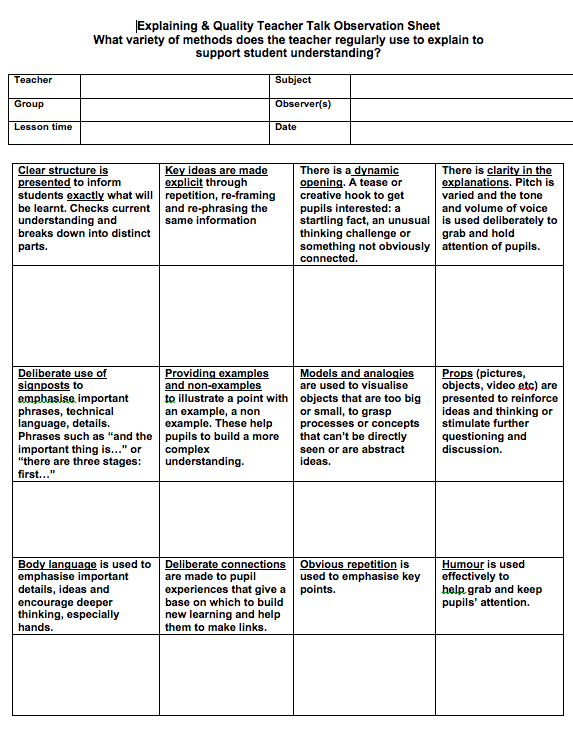
I’ve included a screen shot of an observation format I use very regularly for you to have a look at: ‘Explaining – Improving the Quality of Teacher Talk’ The original version plus others that I regularly use, adapt and tweak can be found in “Full On Learning”. You’ll notice that this is a very focused observation tool, as it ONLY looks at the quality of teacher talk in relation to EXPLAINING. Hence it can be used as part of a developmental coaching approach..which is just how I use it.
I use this particular one as part of my pedagogical coaching toolkit. I’ve got others that focus on questioning and a more generic one that looks ONLY at ‘Pupil activity during the lesson’. They’re all developmental in design as they are limited by their focus on a very specific element of pedagogy. In practice, they work as a simple tally sheet during the lesson. You can add additional layers of complexity, according to what the teacher wants to focus on, but my watchword is and always has been to keep it SIMPLE when it comes to observing the complicated world of teaching and the similarly complex world of learning.
The strength of this tool is:
1. When you work with a group of teachers to create and amend the observation format you get into wonderful discussions and sharing of expertise. In fact, it’s at THIS point when you get the really crunchy discussions about ‘quality teacher talk’ and how various concepts can be explained and what else could be used to aid the communication of complexity, of topic fundamentals and of core concepts so that learner understanding is secure.
2. When used as part of a pedagogical coaching programme, the results can be put into a simple spreadsheet to generate a visual chart (Hans Rosling would be proud!). This then forms the basis of your coaching discussion, as it places the focus of the discussion on the teacher, enabling them to reflect and consider their own practice.
3. Coupled with a skilled coach possibly also with video, you get rewarded by by using this as part of a MARGINAL LEARNING GAINS approach and find that you get those sought-after MULTIPLE GAINS from one simple pedagogical focus.

 Full On Learning