JK Rowling and The Power of Failure

I came across JK Rowling’s Harvard Commencement Speech whilst doing some background research into Carol Dweck’s Mindset work. There’s some great resources there (just click on the link) if you want to do any work with learners on the power of failure here. But, if you can possibly spare 25 minutes or so, I highly recommend that you make yourself a cup of tea/ coffee and take some time out to enjoy this inspirational speech. Then you might want to show it to some students…

Visual Study Skills: bringing words and pictures together (pt2)

Sunni Brown’s TEDx talk needs to be linked up with her great article entitled, “The Miseducation of the Doodle” (you can follow her on Twitter @SunniBrown) all of which are great for the linking of pictures and words. It ties in with some work I am currently developing around how we design learning opportunities that foster visual thinking to represent information. There’s much to this, plus all the joys you’ll find in the field of infographics and a whole host of visual interpreters who are developing their techniques in an effort to make sense of the enormity of the information available to us in the digital world.

I’m sure I’ll find some more links to bring it together. But for now, it makes me think that this is an area that I need to spend more time on when I’m designing learning. One of the integral qualities of a discerning learner is their ability to sort, sift and select the most meaningful tenets of information so that others might access the knowledge that they have discovered, re-interpreted or even created from scratch. For me, this demands that we consider the ways in which we offer opportunities to our learners to be able to present their information. Such presentations of understanding can certainly serve as a valuable and public validation of learner-thinking. In addition, such visual presentations will help to consolidate their own knowledge and deepen their understanding.

The importance of being able to identify the relationships between concepts, ideas and knowledge is a valuable part of the process of understanding. To do this visually not only provides us with the opportunity to ‘show’ our thinking, but enables us to create a very uniques and personal expression of our understanding. With a class full of 30 students, the diversity of the individual expressions is a discussion point in itself. It’s a bit more than thought-showers and mind maps and, as such, seems to be something that I can certainly consider designing as a focus area for deliberate practice in lessons.

Sunni Brown is a business owner, creative director, speaker, and co-author of one of Amazon’s Top 100 Business Books in C&I titled GameStorming: A Playbook for Rule-breakers, Innovators and Changemakers. She’s best known for her large-scale live content visualizations at meetings and events, and she is also the leader of The Doodle Revolution—a growing effort to debunk the myth that doodling is a distraction. She plans to teach the world how to master “strategic doodling” in her 2nd book, The Doodle Revolution.

Creative thinking: Reflecting to bring words and pictures together (pt1)

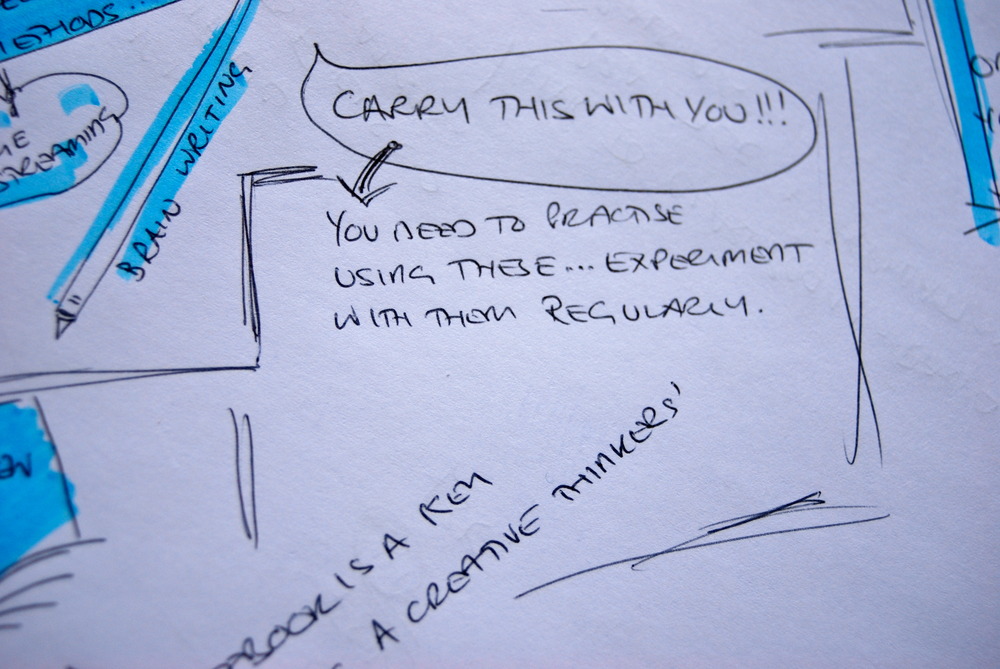
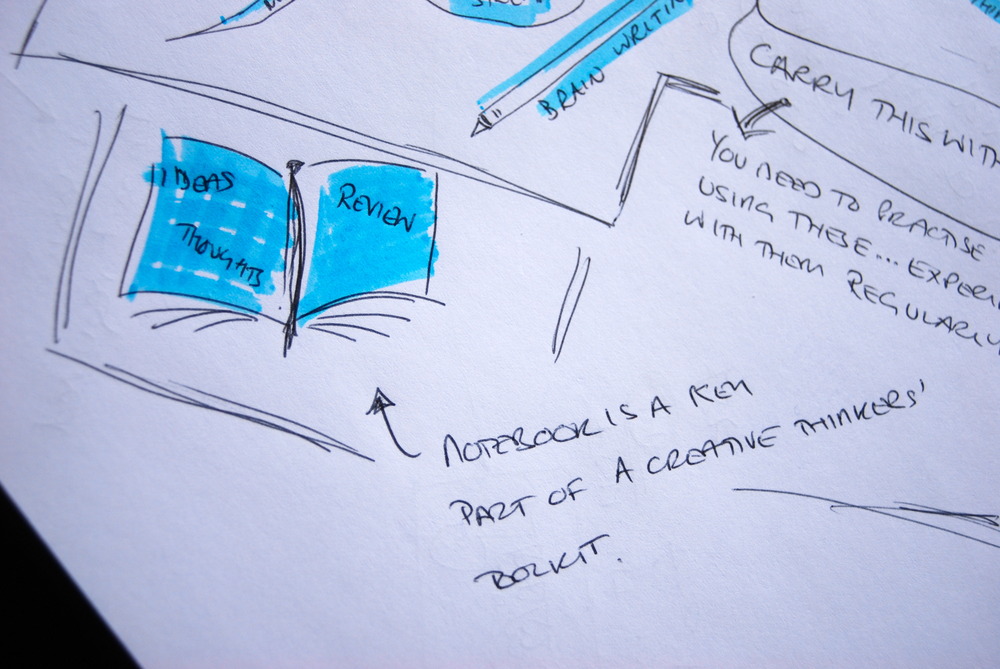
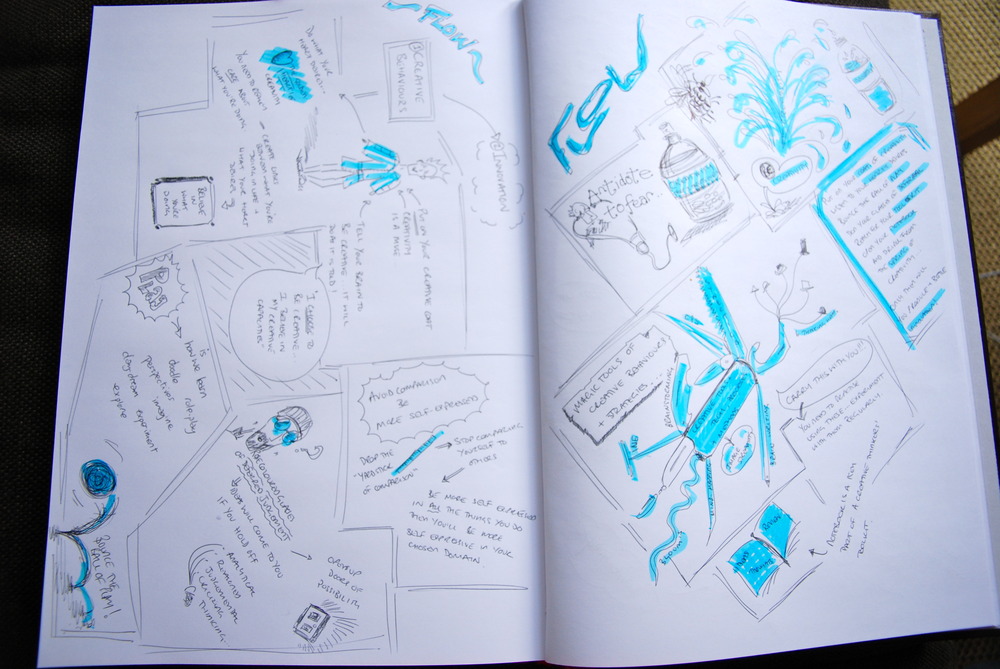
Here is Gregg Fraley @greggfraley speaking at TEDx hosted by NASA.  Whilst I listened, I doodled…only to find that one of his key recommendations was to purchase and use a notebook to capture random thoughts and ideas as we go through the day. How good did THAT make me feel?!

The time when I am able to work from home is precious. It gives me the opportunity to immerse myself in readings, resources and videos that push my thinking forward. It turns out that what I’m able to do during this time is develop my creative behaviours. It makes me consider the age-old tension that we all face between achieving curriculum coverage and offering opportunities for deep thinking.

Trying to design opportunities for learners to respond personally to the issues and concepts they encounter is, without doubt, one of the toughest challenges when it comes to carving up a fifty minute block of time into meaningful learning ‘chunks’.  Perhaps one answer is the development of doodle-techniques, just as I have tried here whilst listening to the talk. We know that the majority of information we encounter is channelled through our visual receptors, so having a focus on making connections between the visual and cognitive parts of our brains is something that deserves more time?

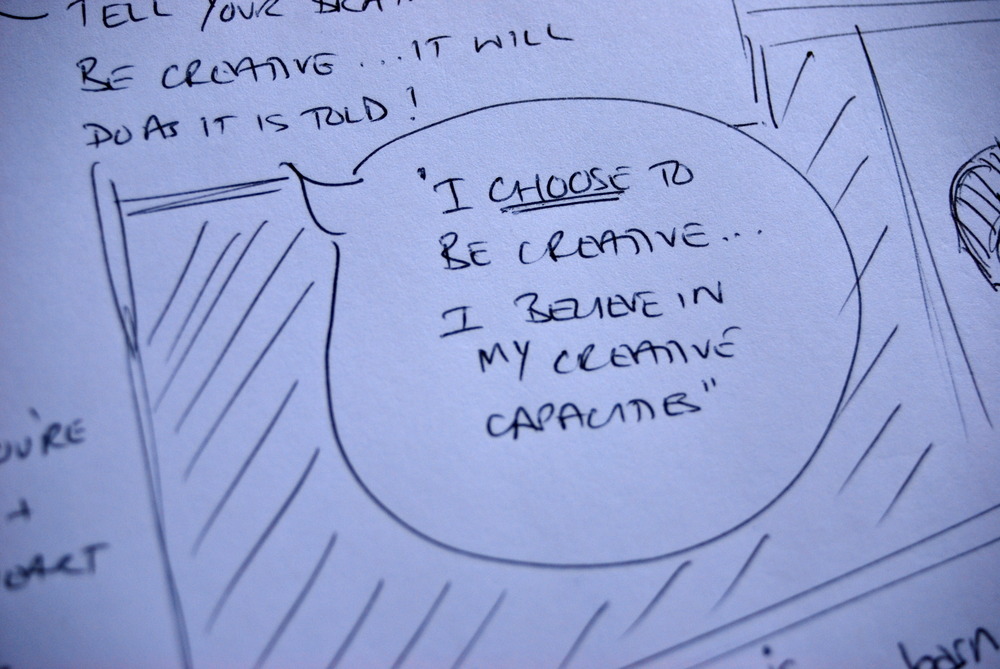
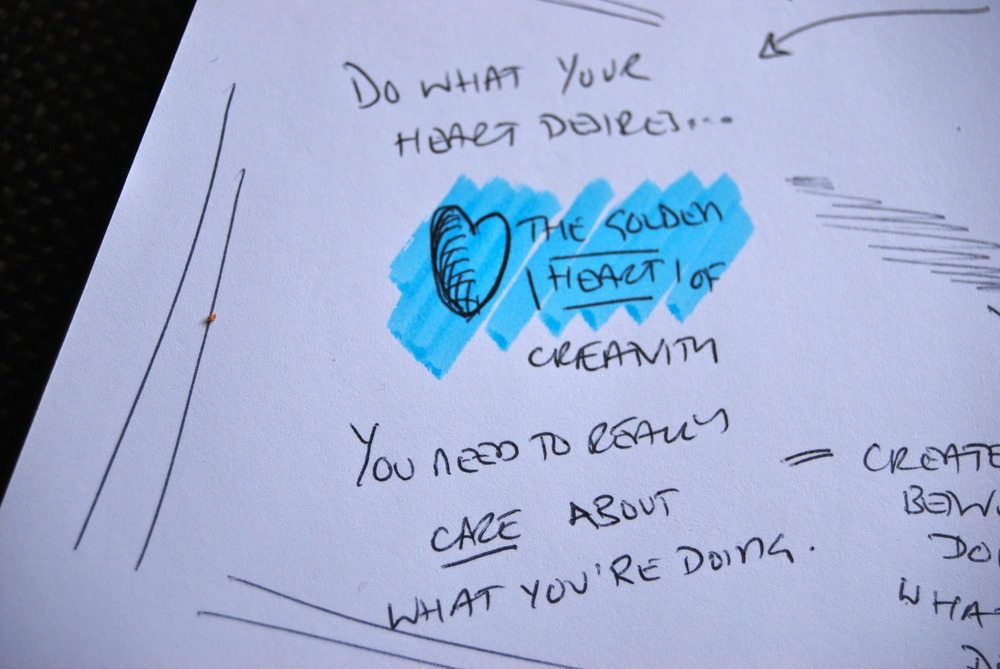
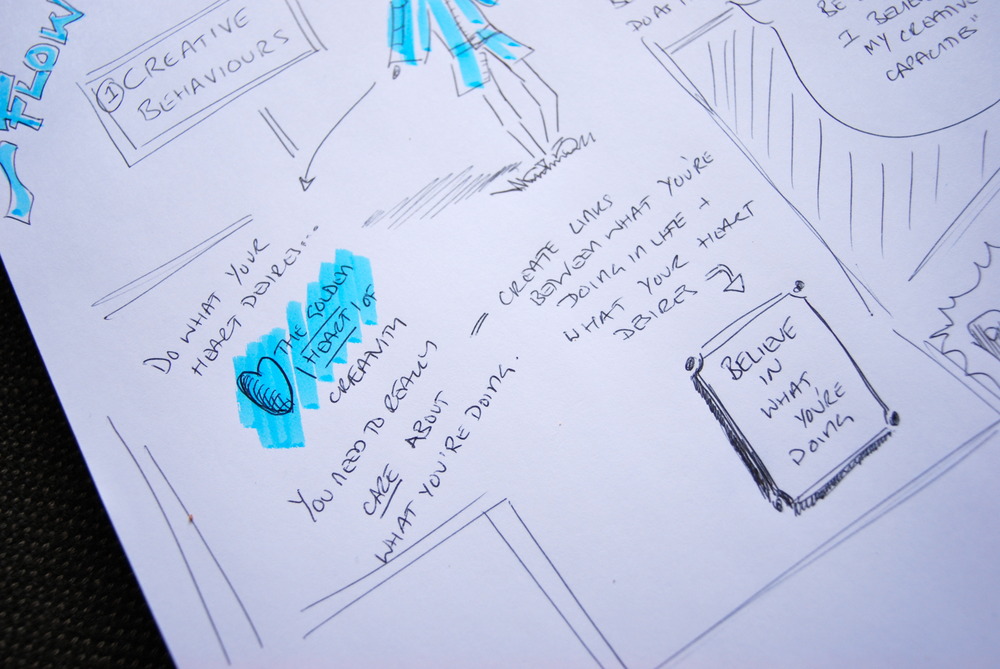
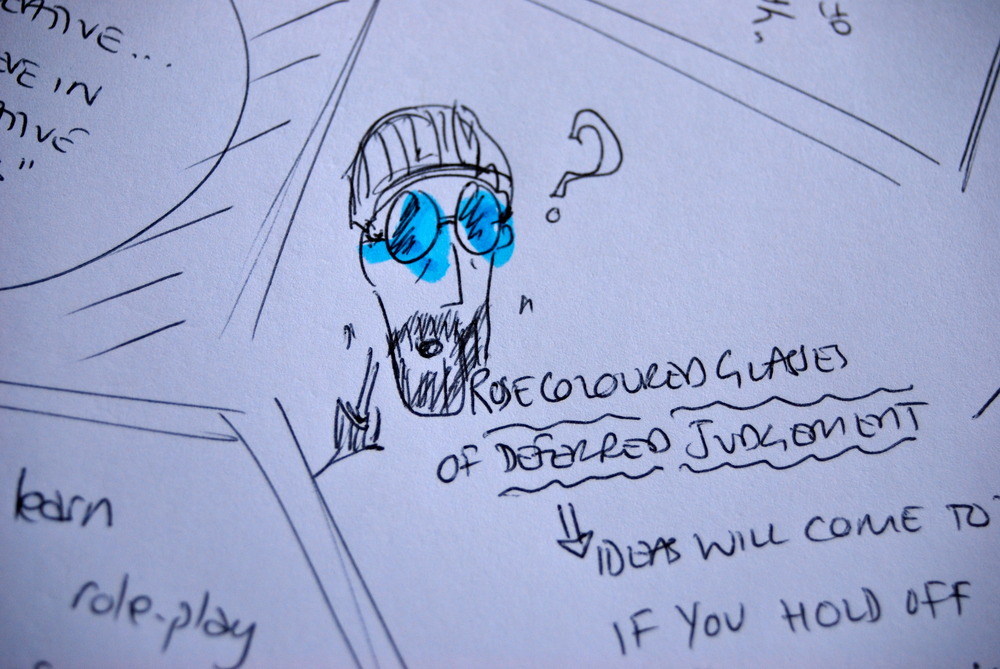
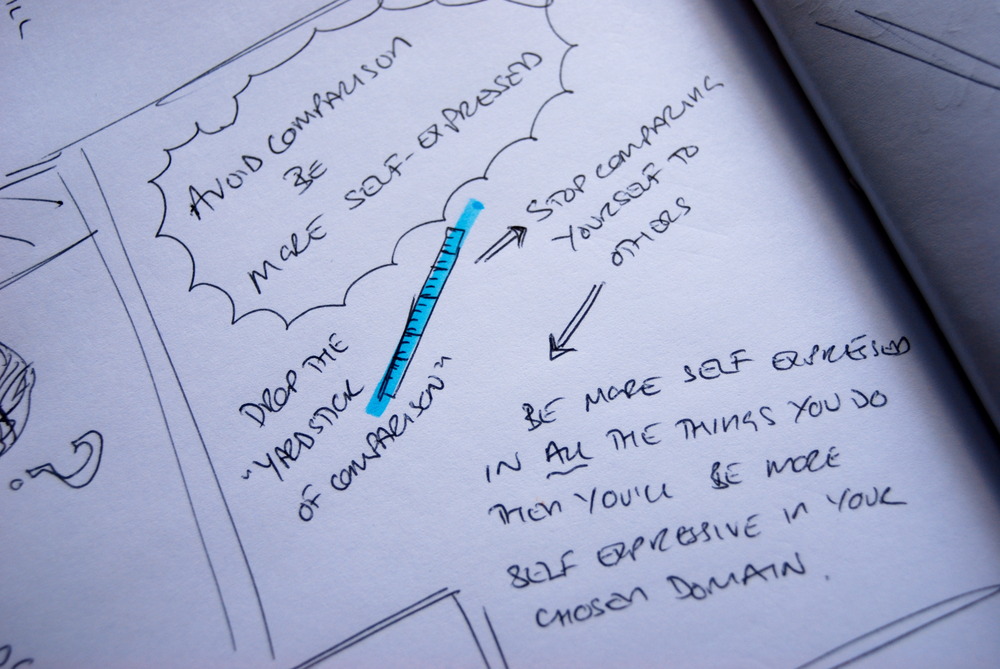
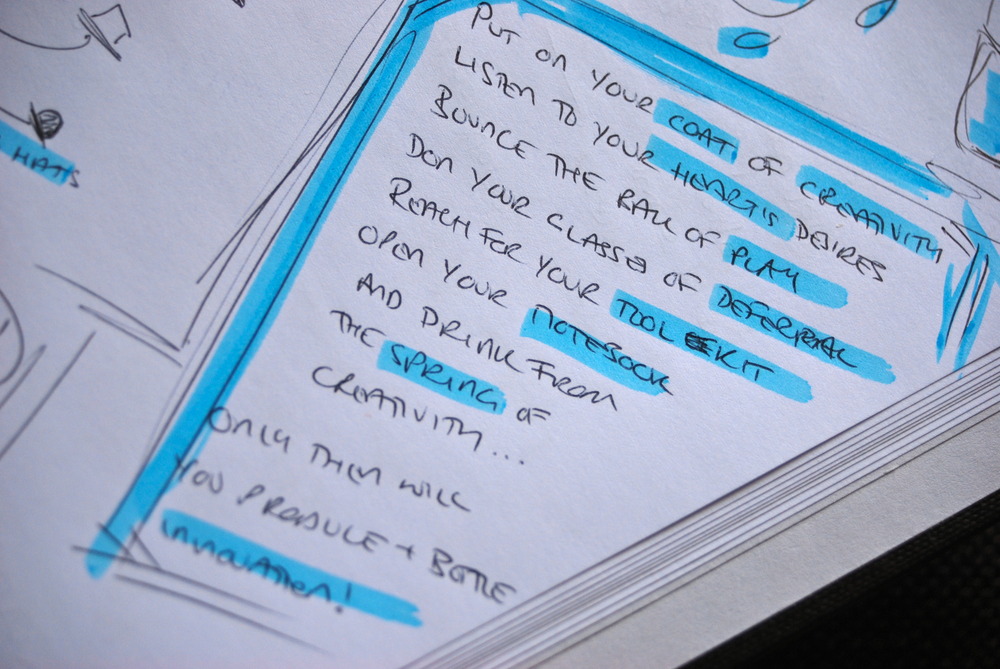
Watch and enjoy…my sketches are below (ordinarily, I wouldn’t have included them, as I don’t feel that they are ‘good enough’. If you wacth the TEDx Talk, however, you’ll see that I have had the courage to remove the “YARDSTICK OF COMPARISON”. I found that they are perfectly valid forms of my self expression – thanks, Gregg!).

N.B. The original TEDx Talk post was originally posted on my main blog site www.fullonlearning.com

Dsc_0023Dsc_0024Dsc_0025Dsc_0026Dsc_0027Dsc_0028Dsc_0029Dsc_0030Dsc_0031Dsc_0032Dsc_0033Dsc_0034Dsc_0035Dsc_0036Dsc_0037Dsc_0038Dsc_0039Dsc_0040


Autonomy: trusting that students really CAN do it for themselves

Sugata Mitra shares his findings from the “Hole in the wall project”. If ever we needed evidence that standing back and allowing learners to explore, discover and learn for themselves, this is it.

So what is the role of the teacher? Has Sugata provided us with evidence that teachers are redundant? Well, no. But it does provide us with an important message about who should be doing WHAT in the classroom and what the role of the teacher needs to be. I think of the role of the teacher in the 21st century as an ‘Expert Pedagogue’. 

It connects, for me, to the work undertaken by John Hattie, found in ‘Visible Learning’. Some of the most powerful findings from this work for me are as follows…

Teaching is an intrusive intervention – I think of this as more of an ‘interruption’ in another person’s thinking. Because of this, we (practitioners) must make sure that these interruptions are both mindful and deliberate. Just as a teacher intervention has the power to accelerate the thinking of a student, so, too can it obstruct the thinking of a student.

Now this is nothing new, I admit. But what it does do for me is to remind me about the importance of every interaction between teacher and student. As far as possible, I need to ensure that each and every one of my interruptions is deliberate and really well planned. These interruptions really need to earn their place in the classroom to make sure that they result in the progression of thinking, rather than the halting of thinking. 

If I mistime my intervention, I may well shut down any deep thinking. I may detract from the requires time and reflection that is integral to the learning process. So for me, it’s about asking myself:

How often do I deliberately hold back and allow people to ponder? When working with teachers, this is can be a particularly challenging thing to do as often, I find it hard to resist the temptation to jump in, push on and ‘get though the stuff…’

What can I do in the learning opportunities that I design that will create and nurture the space and time that is necessary for deep, ponderous thought? What does a ‘Pondering learning environment’ look, sound and feel like? And how would it be judged by others?

What do I need to do to establish a ponderous climate for learning that is both thoughtful and purposeful? 

How much courage will it take to really step back, to observe with my eyes and ears in order to inform my interventions? (And how will this feel for me and for the learners?)

Do I have the courage to test Sugata’s theory that, if left to their own learning resources, learners (adults and young people) will be able to progress their own learning? This will hinge on achieving, as with all the good stuff, a quality balance between mindful interventions and thoughtful observations.

The role of the expert pedagogue is characterised by this delicate balance between the observation of learning and provision of timely quality feedback. This is rests on the ability to foster quality learning conversations that both progress thinking and promote self-efficacy in/ for all learners.

Much to ponder…

Digital discernment: Nurturing our real and digital selves

I write and talk a lot about the capacities and dispositions we seek to explicitly nurture in our learners. Recently, however, there is one particular quality I keep thinking about. This is the quality of discernment. It is the one learning capacity that has, for the moment, started to take precedence over the others. I’m not advocating any form of hierarchy amongst all learning capacities here, but I am increasingly finding that the need for the explicit development of discernment in learners is more pressing than ever. In our saturated world of information, our ability to search, sort and select appropriate, reliable and credible information is fast becoming as important to our digital learners as a compass is for sailors in stormy seas. This is equally the case when it comes to the safeguarding and nurturing of our digital footprints.

I came across this slideshare presentation from Alec Couros @courosa and found that it provided me with some pertinent questions within this topic. It reminds me of the issues we must continue to revisit both as educators and as participants, on our own behalf, in the digital landscape. 

Climate for creativity: permission to copy

Johanna Blakley offers some fascinating insight here into how we can make a distinction between creative innovation and copying. She explores the relatively free-of-copyright world of the fashion industry and suggests that it is this very freedom that forces innovative thinking and discovery. 

Within the context of the classroom, this open-sharing can be a real challenge. When we ask our students to research information that will inform their thinking, we are, in truth, asking them to first discover and second draw upon this existing knowledge to help them construct their own, new (to them, at least) knowledge. What we are desperate to avoid in this process, however, is a student simply copying the information that they discover and replicating what is already known. We want all our students to demonstrate a sophisticated degree of discernment in how they consider and select information as a part of their personal knowledge-construction.

When it comes to asking students to think creatively, then, what must we do? I think that Johanna’s observations here might help. She presents the case that in the least regulated industries, we find the greatest degree of innovation. Why? Because if your idea is easy to copy, then people will copy it. But they will do it within their own context, using the resources available to them and inevitably, it will be an adaptation of the original. It is at the point of adaptation that creative thinking takes place. Just as when 30 students are asked to write their own critical analysis of the same piece of prose, you know that you’ll get thirty different responses. 

This makes me consider the age-old difficulty of how we assess creativity. What must we ask in order to test the quality of creative thinking?

Well, Johanna’s talk prompted me to ponder this (and I am in no way certain as to whether this works or not, so bear with me, please)…

If you come up with something that is truly innovative, something that is underpinned by considered and sophisticated thinking, then this will be far harder to adapt and certainly, harder to replicate. In that way, it can stand alone and become a trend-setter in its own right and, if you’re lucky, not only stand the test of time but reach iconic status, and you with it. It is the depth of thinking that underpins the innovation that is put to the test here, alongside the creative output itself.

So I wonder how we go about assessing the quality of thinking (not limited to creative thinking alone, here). Once we have asked students to draw upon existing knowledge and to collaborate with each other to generate ideas, perhaps we can ask a few ‘test-the-thinking’ questions. These might look like this:

How easy will this idea be to copy? (Show me how you might do this)
How might you improve upon it and make it more accessible, more functional, more relevant etc? (Have a go at making the necessary improvements and adaptations and explain why you’ve made these decisions and changes)
What elements of the original idea will stand the test of time? (Identify these and explain the ways in which you think these elements will ‘stick’)
What might be created in time to replace this? (Create a design/ rationale/ proposal for a replacement idea/ concept/ design and explain how this supersedes the original)

The ideal conditions for this creative thinking to happen are openness, sharing and collaboration. A very different physical and pedagogical model from my own school experience. If this is the case, this serves as a great rationale to use when designing learning environments and considering our pedagogy so that it deliberately facilitates collaborative learning. 

As Johanna states in her talk, the democratisation of fashion leads to the development of trends; people copy others, but as they do, they place their own personal ‘twist’ on the original. To move from trend-follower to trend-setter, you need to stay ahead of the trends. It is here that new innovations are born. But what is also noticeable here is that it is the trend that drives the innovation, not the other way round. 

This makes me reflect upon moving my own pedagogical practice forward. It makes me wonder whether I can use this to reassure myself that the best kind of professional development comes about as a result of the prioritisation of teacher action research and enquiry in and between our own schools. When we think and discuss our world of learning in such an open and collaborative manner, then learning could well start to develop as our very own innovative global brand.  Perhaps it already has? As such it is characterised as a powerful movement membership to which is what everybody craves. After all, if we return to Johanna’s talk and the reasons why fashion is so copyright-free, learning is surely far too utilitarian to be copyrighted. 

So if we can continue to learn together within the open and accessible education community supported by Web 2.0 technologies (blogs and twitter at the very least) and through the establishment of professional learning networks then I reckon we will succeed in maintaining authentic participatory access to the brand of learning to as wide an audience as possible. 

Democratisation of learning is characterised by a shared ownership that cuts across all backgrounds, ages and culture. From within the existing masses of followers of our very own innovative learning brand, we may be starting to see the trend-setters emerging. These are the innovators, the collaborators and the applied ideologists. It is from here then, that new systems of learning will grow and develop which will indeed stand the test of time.

Well, that’s what I was thinking about when I listened to this talk. Thank you to @ICTtower for recommending it. 

New blogging project: TEDucation goes live!

Image

As a result of my love of the many learning possibilities presented by www.TED.com, I’ve finally got around to putting into existence an idea I’ve had for about two years now. I have created a new blog site, www.teducation.posterous.com. The purpose of this site is to capture, organise and create an interactive and reflective learning space that is regularly refreshed by the inspirational speakers of TED Talks and TEDx Talks.

My entire learning philosophy is underpinned by my conviction that we learn best when we are both outward looking and inward thinking. This means that I feed my insatiable curiosity by listening, watching and learning from as many different people doing as many different things in as many different fields. So, if businesses are finding new ways to interact with their clients, then maybe there’s something in what they find out that can be used by us to find new ways to interact with our students. Alternatively, if sport has some insight on motivation, then I reckon we can probably use this in a range of contexts when we’re inspiring young people.

I reckon that TED talks offers a rich environment for us all to collect some pretty good ideas when it comes to how our students are motivated to truly involve themselves in their own learning journey.

I am keen to hear from others using the comments section or emailing me with their own favourite TED talks for learning, so we can build a bigger resource bank of TED-inspired ideas for learning.

I hope you enjoy the site and get involved with the TED talks here.


Independent thinking: discerning learners

Here’s Ian Gilbert from Independent Thinking speaking at TEDx in Dubai. I have the pleasure of working with Ian and I’ve included this talk because it is a pertinent reminder that we need to be brave and keep on doing things differently because the world is different.

We need to maintain our focus on explicitly practising thinking, we just know this makes sense. By teaching children how to be Quality Thinkers, we can help them develop their own capacity for creativity, confidence and curiosity. From this point, they will be armed with the qualities I seek in my work, that of the DISCERNING LEARNER. One who can select, analyse, assess and appropriately apply their knowledge and skills in a responsible, innovative and creative way.
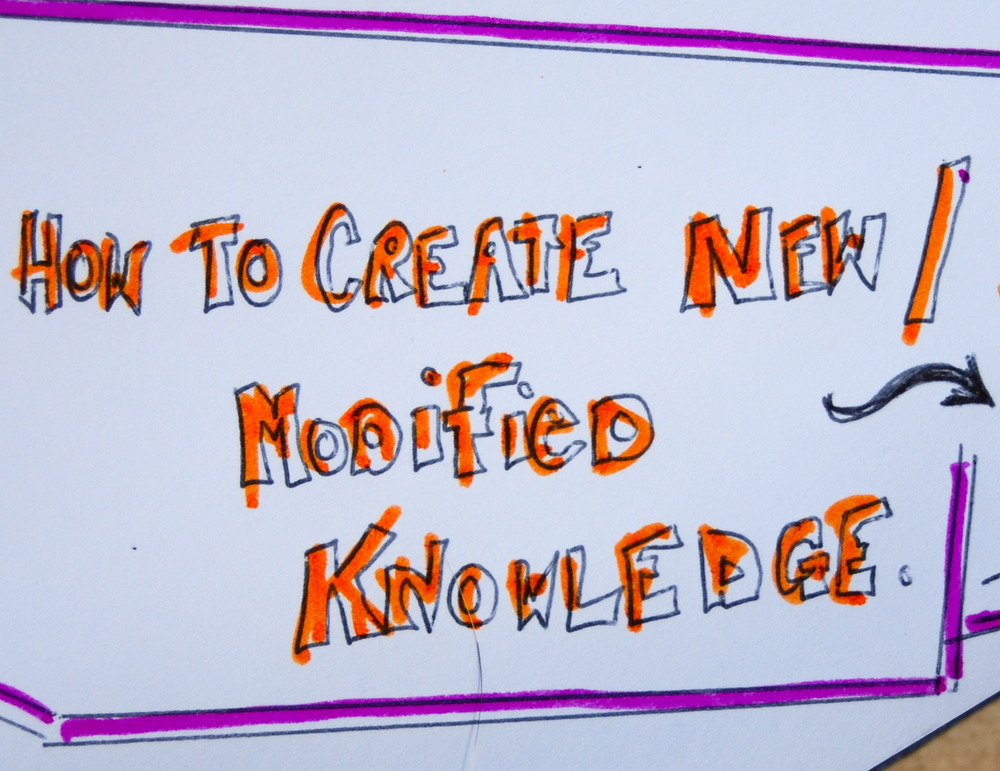
We need to deliberately design opportunities where these learning capacities can grow. We need to alert learners to what these learning capacities look, sound and feel like, so they can recognise them in themselves both when they use them and when these capacities are missing, so they can find ways for themselves to develop them.

Some powerful responses to our questions:

“I don’t know…but I will think about it…” If you hear this in your classroom, you’ll know you’re doing something right!

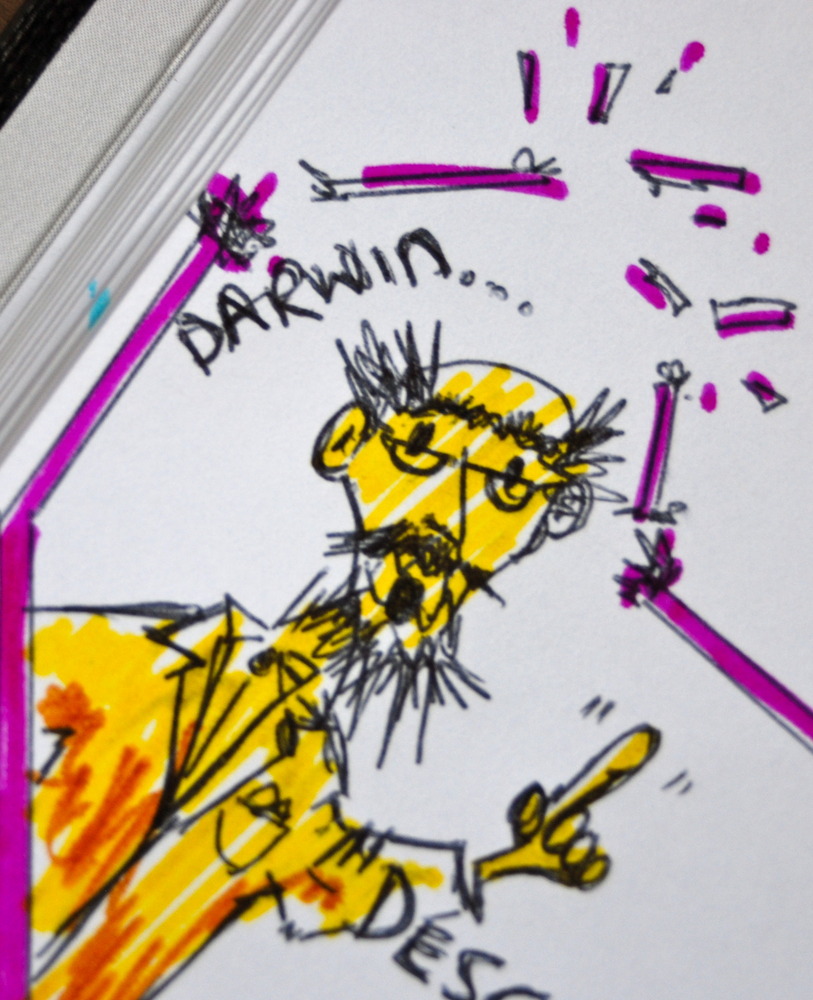
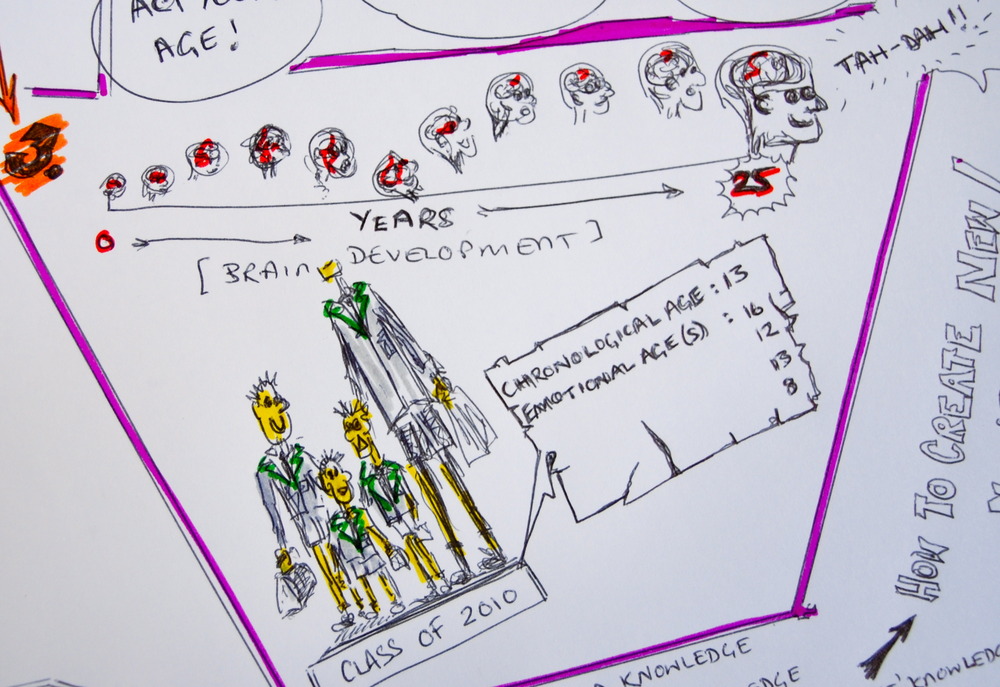
My Thinking-Illustrations are below if you’re interested. This is me, practising the ‘DRAW YOUR LEARNING’ strategy (a great plenary activity to set up at the START of a lesson…a bit of backward teaching for you too!)

Dsc_0023Dsc_0025Dsc_0026Dsc_0027Dsc_0028Dsc_0029Dsc_0030Dsc_0031Dsc_0032Dsc_0033Dsc_0034Dsc_0035Dsc_0037Dsc_0038Dsc_0039Dsc_0040Dsc_0042Dsc_0043Dsc_0044Dsc_0045Dsc_0046Dsc_0047

Serious Play: Freeing up thinking

Tim Brown gives some great insight here into practical creativity in his work place at IDEO. I’ve used many of the activities he showcases here with teachers and students. The 30 Circles activity is a particular favourite of mine. It’s a divergent thinking activity which forces you to generate as many ideas as possible within a given time limit, whilst switching off your integral quality-sensor. So often, we become inhibited by our own preconceived ideas about what is ‘good’. For many, this quality-sensor mechanism is one of the biggest hurdles for us to really tap into our creativity.

I used the activity with a group of teachers recently and they ‘wasted’ 27 seconds of the allotted minute before they made any mark on their paper at all. They spent this time looking nervously around the room at their peers, checking to see if they were ‘right’ in what they thought they had to do. Even though there was no right or wrong. Don’t get me wrong, there’s no judgement here from me on this as all it did was remind me of how great fear of getting things wrong can be when it comes to thinking.

I’ve included the template I use for the 30 circles activity. The only thing you need to remember when using this is:

(1) Be clear that any approach is the ‘right’ approach
(2) Restrict the the time to one minute
(3) Invest in feedback: How did it FEEL to think like that? How confident were you in completing the activity? What were your concerns? In what ways did you feel pressure (from others/ yourself/ me…?)
(4) How could you adapt this and make it a subject/topic specific activity to free up thinking and establish a ‘safe-to-try’ culture of learning?

Relevant Learning: Pirates and superheroes to inspire

Dave Eggers set up his pirates shop as a way to secure a property to house his writing workshops, as you will learn from this video. Since this, a crop of similar projects have sprouted, including a superheroes shop in New York and a whole diverse range of chapters under the 826 umbrella.

Making learning relevant to learners is one of the hardest tasks we have. Dave Eggers discovered, by accident, the lure of practical imagination alongside the power of mentoring. His discovery was to go beyond just asking children to write down or to talk about their imaginative musings but to actively imagine that they can step into their very own imagination and take an active role in them. Alongside this, he put people who had already found their passion for writing in the same space as those who were yet to find theirs. Together, they get to scope ideas, draft their dreams and publish their imaginations. 

When we ask students to get creative or ‘use their imagination’, what is it that we are asking them to do? What do we hope to see? What do we want them to show us? How do we want them to feel about their learning when they activate their imagination? How can we give them the necessary space and time to develop the confidence to really develop their most powerful ideas? How far can we let them really run with their ideas? How far could they go…? If thinking creatively is all about making connections between previously unrelated concepts or objects, then what Dave Eggers has done here works really well.

Consider the topic of Pirates or Superheroes and how you might make some links to curriculum topics and the characters themselves:

Maths: What kind of insurance plan would Batman need for Robin? What sort of premium would he need to pay to protect against damage to the Bat Cave ?

Geography: What route should Captain Jack Sparrow take if he sailed from the Bahamas to the South Coast of Ireland?

RE: What code of ethics would Spiderman enforce if he were made Prime Minister? 

Citizenship: What role in government would The Green Lantern be most suited to?

PSHE: What health issues would Blackbeard need to be educated about and how could he and his crew make sure they stayed healthy?

History: What knowledge, dispositions and skills would a superhero have needed to prevent WW2?

Science: What physiological differences exist between the Justice League of America? Compare these with X-Men and evaluate the ways in one group might be more powerful than the other.

And so on…if you have more reflections or inspirational ideas connected with this, please leave a comment.