Ways to spend your Pupil Premium (plus a great open source infographic programme!)

Strategies_to_improve_learning_pupil_premium_report_may_2011

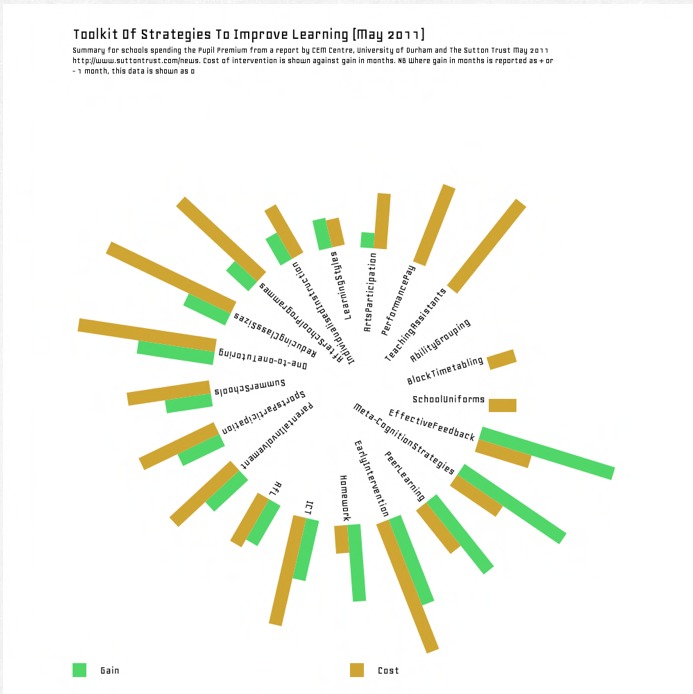
The Sutton Trust, in conjunction with CEM at The University of Durham, has just released a report, “Toolkit of Strategies to Improve Learning” which summarises the ways in which schools might select to spend their Pupil Premium, weighing up potential gains (in terms of months) against estimated cost.

I really recommend going to The Sutton Trust website and reading their own synopsis of the report and, at the same time taking the opportunity to check out everything they are involved with to reduce social barriers to learning. The report itself is a fascinating read, providing as it does, a summary of the research evidence on improving learning  and attainment to help schools make informed choices about how to support their pupils who are eligible for the additional funding that comes with the Pupil Premium. I’ve included the document below.

toolkit-summary-final-r-2-.pdf
Download this file

The infographics at the top and the bottom of this post are my very first attempts to visualise the data on pages 5-7 in the report. The graphic at the top shows the relative cost to gain (in months) for the interventions they looked at. The graphic below is a simmary of the highest impact interventions (aside from the cost).

I’ve just discovered NumberPicture which is a bit like wordle for data. It is a very exciting discovery for a non-coder like me and something I could see learners getting really engaged with.

Screen_shot_2011-05-31_at_13

When NOT taking risks is the riskiest thing to do

PART 1: Indicators

I often hear people talking about the need for educators to have the confidence and courage to take risks and I’ve started to question what that really means. After all, whilst singing a song in public feels like a HUGE risk for one person, for another, it comes as easy as a stroll in the park.

Prompted by some great discussions with a whole raft of people, I’ve been looking into the world of ‘proxy indicators’. In truth, I have been dealing with these things for some time now as part of my action research work around creativity, quality learning and self-evaluation processes. These have all lead me to ask three important questions whenever I’m working alongside colleagues to unpick the intended outcomes of the quality of learning they are either intending to design or have just delivered:

Example: Encouraging learners to think creatively in science…

What did this look like? …learners’ body language was ‘open’…they used encouraging hand gestures towards each other when they were clarifying ideas…they made good eye-contact with each other…they smiled…they were animated…

What did this sound like? …there was a ‘buzz’, conversation within groups was focused on the task at hand…they asked questions of each other and of the task…their discussions used ‘piggy-backing’ to build a consensus…’yes…and’ were used (rather than ‘no…but’)..it was noisy (not rowdy!)

What did this feel like?…for me, I felt ‘free’ to observe, question and coach…I felt they were in control of the direction of the task…they reported that they felt ‘lost in discussion’ and lost track of time…the lesson went quickly for us and we agreed that we wanted to stay until we were finished…the bell annoyed one learner so much that she said as much on her post-it note for the feedback wall.

The richest of these conversations naturally lead into the world of micro-teaching, which is where we can identify how the smallest of interventions, words, reactions can result in ‘learning impact’. John Hattie has done some brilliant work on this in “Visible Learning” and there’s a connected resource at Geoff Petty’s website that’s well worth looking at. What it comes down to is consciously knowing, at a micro-level, what we can do as designers and deliverers of learning that will result in PROGRESS in learning.

PART 2: Risk-taking

So, whereas I am certain that I will be posting more on all of this as my research continues, I thought I’d put some ideas about the proxy indicators of ‘risk-taking’ out to readers of this blog.

Question: What does ‘risk-taking’ for an educator really look, sound and feel like? How do I recognise risk-taking in my own educational practice when it happens and what do I consciously need to do to ensure it becomes characteristic of the learning that I promote?

Suggested indicators for some might be…

STANDING BACK: for many educators, being quiet, stepping away from the reins and letting learners ‘just find out’ and make their own discoveries (and mistakes, for that matter, if you name them that), will be the riskiest thing we can do. Consider what tends to happen when any kind of judgemental observation takes place. Consciously standing back certainly feels like the riskiest option when there’s somebody grading the progress of your learners as they get to grips with the task you have set them. 

MAKING IT HARDER: if learners are to make progress in a lesson, they have to experience some kind of change. From the moment they enter the lesson, they need to think, consider, explore, puzzle and probe to make a discovery that will lead them to take something (new knowledge, understanding, insight, skills, abilities or capacities) away from your lesson that they would have missed out on had they not been there. Ensuring that this progress is significant and meaningful involves posing questions and tasks that are authentically CHALLENGING. To do this, we need to think about what learners will find difficult and start from here as the entry point to the curriculum we are offering.

ASKING NOT TELLING: when the moment of struggle surrounds our learners, we have a critical decision to make…provide or hold-back. Perhaps it feels like the riskiest thing in the world to us to not give a solution to a learner when they are clearly struggling. It may well feel like the toughest thing in the world for us to respond to a solution-seeking question or request by to asking a question. But that question allows the task of learning to remain in the hands of the learner. The riskiest questions from us might sound like this:

“How might you find that out?”

“Who else in the class might be able to help you with this (other than me)?”

“What else could you try to solve this one?”

I’ve got some more indicators, but this post is already MUCH longer than I intended, so I will leave them for another time. 

Some may argue, that in the world as it is and the world as it likely to be, to ‘play safe’ and continue to do the things that feel safe to us is, in fact the riskiest thing to do. I am really interested in what you think about this and I would love your feedback.

Here’s a creative challenge for your learners…

How about asking learners to create a stunning online CV that SHOUTS out who they are and what they are passionate about? I’ve just come across this fantastic example from Chris Ferdinandi (@ChrisFerdinandi). It made me think about how I could use it to inspire learners to tell me more about themselves to build a really safe and authentic learning community. Alternatively, older learners might use a similar approach to drafting their UCAS statements. Wouldn’t it be nice if a university or employer started requesting CVs in this format? Maybe, very soon, they will…

Exciting times ahead & some sensible words

It’s been a ridiculous length of time since I last blogged. This is indicative of the huge upheaval I have been experiencing in my current role. I am the first to say that its only when you feel uncomfortable that you know for sure that there’s some powerful learning happening, so I guess I’m stacking up those learning points at the moment. Wouldn’t it be great if learning points translated into air miles or club card points?! I’m sure somebody has done that already…but what an interesting way reward great learning (not motivate, please note – being of the Mindset school of thought!)?!

Anyway, I’ll have lots of things to share and seek your thoughts about very soon. I’m currently involved in setting up a very exciting coaching network programme, developing action research groups (as always!) and getting a bucket-load of immersed experience with some great practitioners and learning communities. 

In the meantime, in the midst of discussions about the curriculum, wanted to share a post from one of my online friends, Anthony Wilson, who posted an article from Joe Hallgarten of CCE. I worked on a project led by Joe a few years back and I have always been really impressed with his thoughtful, insightful and most importantly incredibly sensible approach to powerful and creative learning opportunities. So, here is the post – thank you to Anthony for posting this on his site and alerting me to it.

From the TES via Anthony Wilson:


A primary school in Tower Hamlets wants cameras to play as great a role in children’s lives as pencils. With the help of filmmakers and parents, teachers are immersing their curriculum in film opportunities. In a Nottingham comprehensive, Year 8s are learning mathematical and design technology through the creation of fashion products and a show. And in a special school in Wolverhampton, students have been exploring their identities as “superheroes” with support from disabled and able-bodied artists.

I have recently witnessed these practices, and many more, having spent March visiting Creative Partnerships’ Schools of Creativity. Their approaches to curriculum development are both inspiring and, I believe, not atypical. Throughout the country, schools are designing rigorous new curriculum models with their communities, giving weight to literacy and numeracy equal to other areas of knowledge and skills.

I have never felt a greater contrast between the optimism of what I have been seeing and the pessimism of what I have been reading. I wade through emails from various alliances, campaigns and consortia, exhorting me to support causes that must be included in the new national curriculum.

I understand their rationale; even with an “entitlement” curriculum of 10 subjects, many areas of learning have been squeezed out of all but the most confident schools. The arts were marginalised, often becoming a poorly taught Friday afternoon “reward” for good behaviour. Citizenship education, although statutory since 2001, has never quite taken off. If that is the picture when subjects are compulsory, how will they fare if removed entirely?

However, these campaigners are missing the point. The most important message in the curriculum review’s remit is that “schools should have greater freedom to construct their own programmes of study in subjects outside the national curriculum and develop approaches to learning and study which complement it”. The national curriculum is not the whole curriculum; it may not even be half of it, and, regardless of ratio, it isn’t necessarily the most important part.

My belief is that children should be political animals, sharpening their elbows to prepare for the Big Society. I would love all children to enjoy at least 50 cultural experiences a year, although my list would extend from education secretary Michael Gove’s 50 books to a broader canon of literature, theatre, visual art and the odd ’80s album. But I also believe that when it comes to the national curriculum my views are irrelevant.

So, instead of pleading for the maintenance of the current curriculum or the addition of new content or skills, I ask those in power to commit to four things.

1. Keep it slim – you did promise

The Finnish national curriculum fits under a door. This should be our role model. If we keep to the four subject areas proposed, we have a chance of achieving the brevity required. However, there is a risk that the national curriculum could still expand to fill all the time available. For Government to define how much time should be spent on it wouldn’t be an act of prescription but of bravery. Sir Robin Alexander, who led the Cambridge curriculum review, has proposed 70 per cent. In private, Mr Gove has apparently suggested 50 per cent. I will split the difference: schools should spend three days of every week, or three hours of every day, on the national curriculum.

2. Demand breadth and balance, but don’t define either

Ofsted frequently confirms that the most successful schools offer a broad and balanced curriculum. Unfortunately, that has never stopped our least successful schools from moving in the other direction in an attempt to improve results rapidly. However, it should not be the job of a national curriculum to define the boundaries of breadth and balance. Schools and their communities can do this themselves.

3. Make sure schools are accountable for their whole curriculum

This would require a real rethink about the accountability and assessment regimes that underpin and sometimes undermine the good intentions of most curricula. We need an equal status between the curriculum defined nationally and what emerges locally. The proposed new Ofsted framework will be the key factor here.

4. Once it’s done, step away

When the review has been completed, Government must resist the temptation to interfere. At that point, schools have to be free to do things that Gove and others might hate; from the way the national curriculum is delivered, to the addition of new subjects, skills or areas of learning.

The importance of the curriculum can sometimes be overstated. It is just one lever in a complex machine of control mechanisms. However, this Government’s approach could witness the greatest devolution of power to schools for a generation.

One member of the review’s advisory committee has described this great curriculum giveaway as “a hell of a gamble”. Although many fear whether teachers have the skills to become curriculum creators, and others doubt whether policymakers have the willpower to stand back, I am keeping the faith. The collaboration, courage and creativity of teachers can make this a gamble worth taking.

Joe Hallgarten is director of programmes for Creativity, Culture and Education and an associate fellow at the Institute for Public Policy Research.

For more on Schools of Creativity, visit www.creative-partnerships.com/about/schools-of-creativity/.