Developing expertise (gifts & talents)

The issue for me at the moment is to support schools in their endeavours to make learning skills explicit within the context of learning delivered. Basically, where I’ve got to with the whole skills versus knowledge debate is that I don’t think think that there is a need for us to talk about ‘skills’ OR ‘knowledge’ as we clearly need both. Developing skills for learning requires a context with purpose. Effective learners have both subject (domain) expertise AND skills to enable them to deepen their knowledge and understanding. In addition, they also have the appropriate dispositions that enable them to learn effectively with their peers. This boils down to three essential planning questions…

1. What do I need to know? (knowledge and understanding)

2. What do I need to be able to do? (learning skills)

3. What do I need to be like? (dispositions)

A most excellent colleague gave me this analogy today…”…think about Stephen Spielberg. He has fantastic subject (domain) expertise when it comes to film-making, and he certainly has some superb generic skills around problem solving, creative thinking, analysis and so on. He also has dispositions such as the openness to new ideas, empathy with others and the understanding of human emotions that enable him to employ his generic skills appropriately within his specialised domain. But take him out of his specialist domain of film-making to problem solve the global deficit and he would be a novice, with absolutely no certainty of success.”

New context requires new KNOWLEDGE. The skills and dispositions are, in many instances, generic, but it is the subject or domain knowledge that is critical to the development of expertise.

We need it all.

When I work with teachers all over the country I am able to consolidate my thinking around these issues and the last two weeks have been particularly valuable for me. I spoke in Malvern at a conference about this, with particular reference to the development of expertise (gifts & talents) within a competency-based curriculum and it really helped move my thinking forward. I then visited a fantastic school in Leeds to see the Critical Skills Programme in action and coming up is a presentation at the Curriculum Foundation Conference in Birmingham. I’m hoping that by the end of this next week…

I’ll have my arguments thoroughly sorted. In the meantime, here’s the resource that I put together for the Malvern event. It’s the next step on from the last resource I put together and I am already developing the third version with a greater emphasis on dispositions. If you click on the centre of the booklet, you’ll get it in fullscreen. If you do find this useful (or not, for that matter), I’d love to hear your thoughts, so please comment or tweet me.

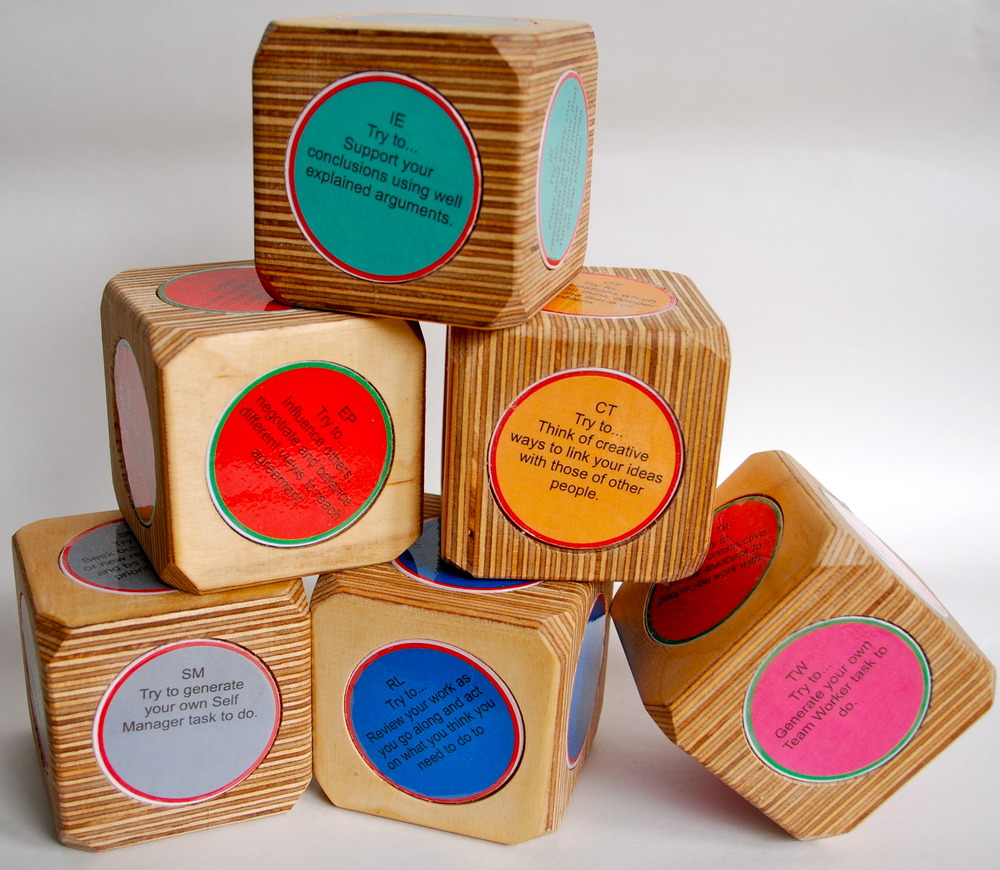
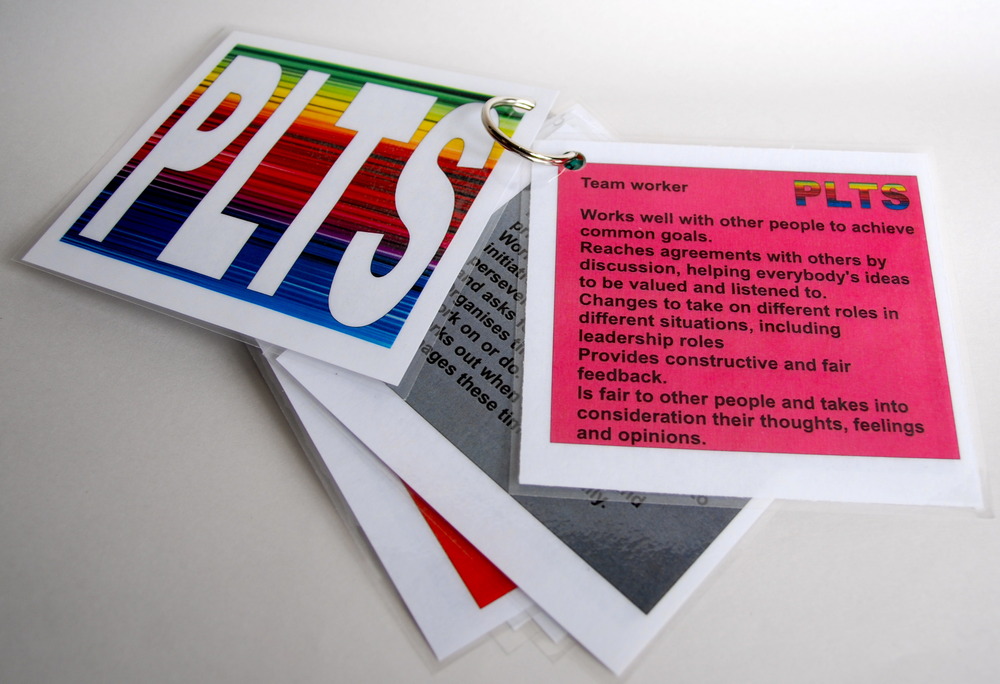
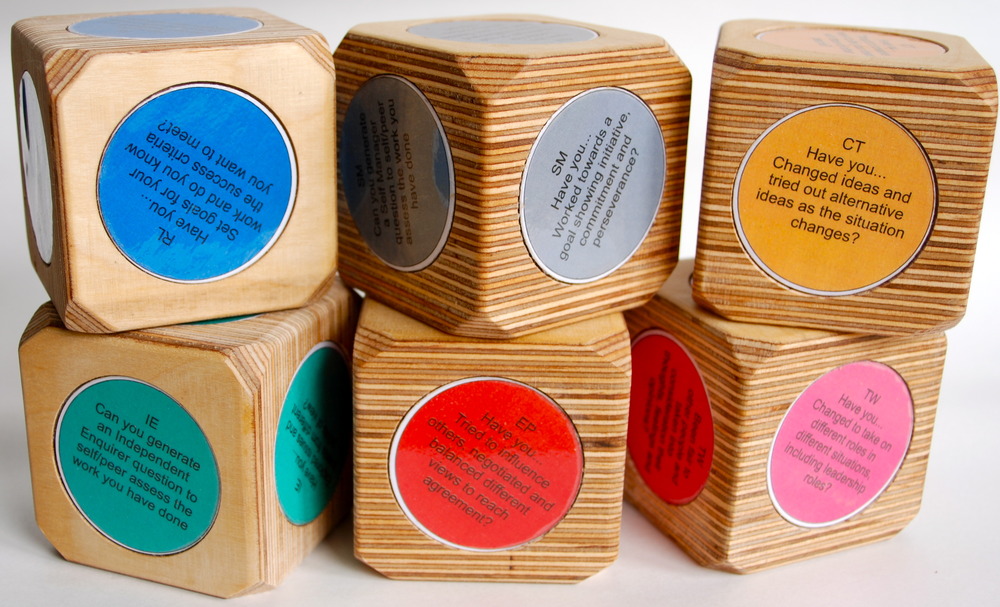
PLTS resources created through fabulous collaboration

(Taken from an original post on a PLTS Action Research Blog)

These resources are under development with the PLTS team at the moment….it goes something like this…

(1) Have an idea

(2) Ask, “I wonder if…?” within earshot of team members

(3) Prototype gets developed

(4) Prototype is tested and refined both in terms of its design and its application to task

(5) Prototype becomes a real resource

We are a great team!

The resources are designed to stimulate QUALITY LEARNING CONVERSATIONS, using the language and concepts of the PLTS. We’ll let you know how are ‘field trials’ go.

The dice are designed as one per PLTS, in two versions, one set is to be used reflectively with the prompt of ‘Have you…’ and the other set is to set PLTS targets ‘Try to…’. They are made out of wood and are, in themselves, things of beauty! The swatch cards are for teachers to refer to when they are observing learning, to support the integration of PLTS language and the cards are for learners to use to reflect and develop the PLTS as a shared language for learning. We’ll be road-testing them all with our project teams of Confident Communicators on Thursday, when we’re holding the Presentation Day for the project. The day is being run alongside an LA AfL teacher conference, and the teachers will attend some of the presentations as a CPD workshop to have a go at observing the PLTS in action using ‘Observing Learning’ techniques we’re developing.

Dsc_0023
Dsc_0024
Dsc_0025
Dsc_0026
Dsc_0027

G&T and PLTS – an integrated approach

I’ve put this together in response to a really good question, “How do we ensure challenge for our most able in a competency-based curriculum?”. A similar question that was posed to me when I gave a presentation to a regional group of English Local Authority Advisers.

I was explaining the potential of PLTS to support the development of gifts and talents using, as a case study, my work with a G&T Lead School to develop G&T provision through the Personal Learning Thinking Skills. This approach is working really well for the school, not least because it has prompted some in-depth discussion. They have been able to explore the tension between emphasising knowledge, subject expertise and generic learning skills in constructing learning opportunities. The group to whom I was speaking had similar reservations and were very concerned that in using the PLTS as the basis for identifying high ability in English, the distinctive subject expertise might be lost. I was able to reassure the group (I hope) that by using the PLTS as a start point and then linking this to subject-specific characteristics of high ability, identification of and provision for the most able would be far more complete. Following this discussion, I started to put together my thinking and came up with the following document (below).

Please have a read of the document (click in the centre for full screen) and I’d be very interested to hear your comments. I’m also keen to hear about what you are doing in your schools. You’ll see a reappearance of my underground maps and you’ll also see some of the practical activities I use in the classroom to create challenge. I will also post this entry on our PLTS Action Research Network blog, which is password protected at the moment, but we’ll open it up if there’s enough demand.
 
The meta-menus featured in this document are from the FABULOUS G&T Pocketbook by Barry Hymer – I HIGHLY recommend getting yourself a copy of this little gem of a book!
 
Much of the content in this document which will be featured in my book…consider this a teaser…!