
Three professional duties…?

Curious, Share, AcknowledgeFIRST: ‘We have a duty to be curious’

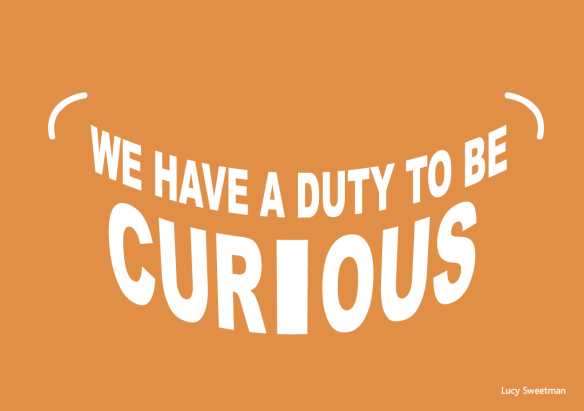
The assertion that we have a professional duty to be curious is taken from the words of Lucy Sweetman (@lucysweetman) and, with her permission, I used her quote in this illustration from Full On Learning:
Screen Shot 2013-02-11 at 21.34.06

I would be amazed if there was anyone who works with children and young people who was not inherently curious. For therein lies the strength, if not the lifeblood, of not simply what we do but, who we are. We are insatiably curious. We exercise this curiosity every moment of our professional lives because it sustains us. And it is probably why we do what we do. Seeking out a battery of ways that enable very different learners to make a connection with the ideas, concepts and information that we lay before them is driven by our curiosity to understand, if not, decode the complexities of learning.

To exercise professional curiosity requires elements of introspection and outrospection in  equal measure. We need to be introspective and insatiably interested in our place in a world that is the world of our classroom and our school community. We then skilfully employ the powers of outrospection to reveal for our learners how what they are learning and experiencing relates to the wider world.

When it comes to outrospection, our creativity and ingenuity has an opportunity to jump to the fore. Forging connections between our world (that of our individual classroom and school) and the world  beyond (other schools and external research and evidence) is a natural process. The opportunity and challenge to be truly curious is to make connections between our classrooms and the worlds of business, engineering, fashion, design and scientific exploration, to suggest just a few. To consider the ways in which business and industry has created systems to engage their employees and / or their customers can provide valuable insight into ‘What motivates us?’ as in this post and to learn about the underpinning design process for the London Underground offers opportunities to devise powerful approaches to differentiation or even how to organise the traffic flow in school buildings, as in this post on ‘Phased Disclosure’. Just one look at www.Informationisbeautiful.net and the accompanying book, ‘Information is Beautiful’ by David McCandless enables us to see the power of visualising data to explain complex information and processes…and how we might encourage learners to use visualisation to present their learning.

For a great talk on ‘outrospection’, here’s an RSA Animate production. It’s a far-reaching talk by philosopher Roma Krznaric about the importance of EMPATHY as a powerful force to bring about change and there are some interesting applications to the realm of educational sharing and development which are too many to include in this post.

The professionally curious are the professionally enriched. It is because of this that they are also the enrichers, the inspirers, the synthesisers and the generators.

SECOND: ‘It is our professional duty to share’

This ties in with some of the themes covered in the RSA video above, but the importance of sharing as professionals was brought to my attention by a comment made by the fabulous educator, John Tomsett (who tweets as @johntomsett and blogs here), who simply stated that every educational practitioner, ‘…has a professional duty to share’.

Trying to encourage educators to blog, to document and to Tweet comes down to just this, a ‘professional duty to share‘.

Every day, we share our understanding, knowledge and our experience with our learners so that they can relate and connect with new knowledge. This is made possible through a repertoire of learning strategies, the skill of pedagogy and the design of the curriculum. When it comes to professional conversations, through informal and formal opportunities, most of us just can’t help ourselves when it comes to sharing our ideas about learning. It is, after all, what we do every day. Our business is, fundamentally, a sharing business.

Ensuring that our schools grow as regular and habitual places of such sharing comes about through a systematic approach that actively expects sharing to take place. Many schools who have this in place are now no longer in a position to require educators to share because it is now so embedded that it is part of the culture and, they might say, ‘just the way we do things here’. The challenge is for us to move to a place where the process of sharing is an institutional priority that underpins (and thereby facilitates) daily practice. It then becomes an integral part of the culture of the school and the habits of the members of the school community.

The aspect of Tim Harford’s book, Adapt: why success always starts with failure that most struck me was his proposition that the best ideas come from those who know their context best; from those on the front line, on ground level and who are front-facing. So the duty to share extends from an individual duty that all practitioners have to becoming a duty of schools to seek out and implement the most effective ways for those practitioners who ‘know best’ to connect.

Organisations such as schools who find ways to capitalise on the informal opportunities for sharing that in the frenetic pace of school life are already on the front foot.  By taking the next step and committing time to designing systems that create formal opportunities specifically and exclusively for the sharing of effective practice, for problem solving and solution-finding, the interactions and genuine collaboration will flow. The first step in this process is to make it a requirement for practitioners to share ideas and spend time with each other so that the second step evolves very naturally for practitioners and sharing in all manner of ways becomes a habit.

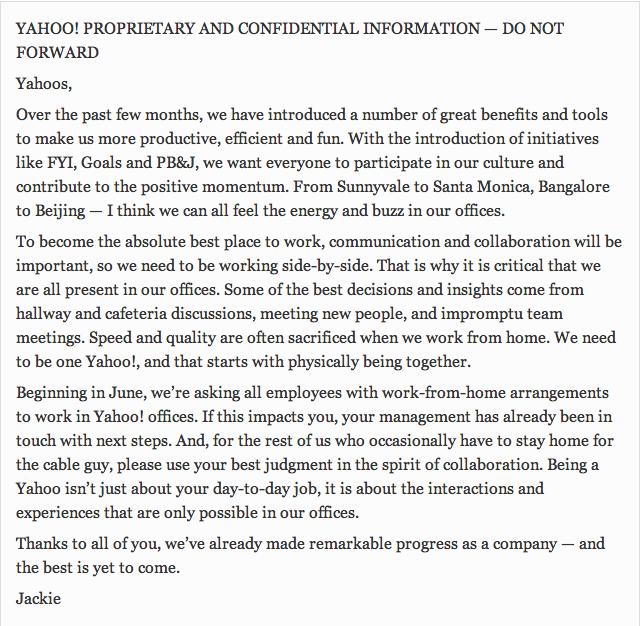
I read recently that Yahoo! has caused controversy by ending work-at-home arrangements. The anger from those affected resulted in the publication of this internal memo and the initiative was reported in “All Things D”.  Don’t get me wrong, I am a big fan of working from home (that’s definitely one for another post), but the rationale for Yahoo!’s change in policy is fascinating, particularly in light of the type of company that Yahoo! is. It would seem from Yahoo!’s stance that they have made human contact and physical interaction a priority for on-going innovation. In this, it would seem that they acknowledge that the value of both informal and formal opportunities for collaboration is too great an opportunity for the company to miss out on, “We need to be one Yahoo!, and that starts from being physically together…Yahoo isn’t just about your day-to-day job, its about the interactions and experiences that are only possible in our offices”…interesting indeed.
Yahoo Memo

THIRD: ‘We have a duty to acknowledge’

GodfreyKneller-IsaacNewton-1689

Finally, we must never lose sight of the third point of the professional triangle, the ‘duty to acknowledge‘. In our collective endeavour to increase and secure our understanding of the oceans of information in which we swim, it is all the more important that we acknowledge the wise words, new insights and droplets of ingenuity that wash over us. Somebody once quoted the famous words of Isaac Newton to me when I was creating a bank of footnotes in an article, stating,  ‘The thing is, Zoë, we all know that we stand on the shoulders of giants…but there’s no need for the giants to be in the shot’. I have thought about this for a long time and I disagreed at the time and I still do. It is absolutely imperative that we keep the ‘giants’ in shot. The sharing of an idea  that is inspired by a conversation or reading is far more meaningful when the original spark of inspiration is placed centre stage in the spotlight. This acknowledgement is an integral part of professional curiosity.It encourages others to seek out and connect with the origins of the idea for themselves. So that others can adapt and create new meanings, thereby enriching the initial spark and fuelling it to shine brighter and for longer.

The way in which educational professionals engage with Twitter is, for the most part, an exemplary testimony to a shared professional endeavour to SHARE, BE CURIOUS and ACKNOWLEDGE. There are lessons in this for our students as they immerse themselves into the exponentially increasing banks of information that characterise all our lives in the 21st Century and when we discuss the uses and opportunities presented to us through social media.

So now, perhaps more than ever, as technology continues to give us the opportunity, we should actively embrace our individual and institutional professional duty to share, to be curious and with this, our duty to acknowledge.
Ask a quality group about group work and this happens…

Who are the best people to ask about group work? 

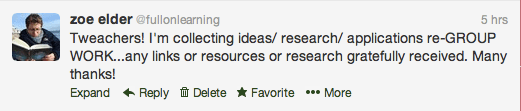
So I put out a tweet to a really high quality group: The Tweachers…

Screen Shot 2013-02-17 at 18.59.09

Here’s what came back:

David Didau (@learningspy) “Effective Group Work” which was endorsed with a re-tweet of this link by Eric Wareham (@developingTandL) plus a second link from David here: “The Ultimate Teaching Technique” and  “Why group work works for me”

John Sayers (@JOHNSAYERSA picture of this group work assessment grid

Andy Day (@AndyphilipdayMonitoring Group Work: Charting its Progress

Robin Trangmar (@yrathro) sent links to documents in Dropbox:

(1) Student Learning Groups

(2) Teaching Small Groups

(3) Group Work Doers

Alex Battison (@alex_battison) tweeted: “Hi Zoe, harkness tables, at Exeter Philipps university (and prolific at Wellington college), are good things to investigate…they have rules to create group work that is completely student led. I have also looked to develop this in my lessons…students have created a list of rules for effective group work.”

Paul Sturtivant (@paulsturtivant)  tweeted: “Is your ScaRf NEAT? Successful group work Roles for learning Noise Equipment Attitude Time”

So, if you’re doing some thinking, maybe some action research or simply reflecting on learning design and considering what ‘quality group work is all about, here’s some resources to keep you going…not a bad effort for a Sunday afternoon. And all the while, this rich vein of expertise was flowing in, I was walking in the sunshine in a beautiful National Trust Property…who has time for educational Twitter?

A Mēlée of Mistake Monsters

Risk-taking and Mistake-(Monster)-Making

In high quality learning environments, risk-taking and mistake-making go hand in hand. Establishing a learning community that is both safe and challenging represents a fascinating tension. We know that encouraging a risk-embracing culture in any organisation is critical to the effective growth of a productive community of learning. The challenge is to find ways to make it okay to take risks; where mistakes are welcomed as learning opportunities rather than failures. In practice, however, this presents us with complex tensions.

We need to explore those times when taking a risk may simply be recklessness. After all, to become an effective risk-taker, we need to employ sophisticated skills of discernment and analysis of the situation. We need to use our ability to think through the consequences of the potential outcomes but this is a tough call when we may be trying something entirely new and the possible outcomes are, by definition, unknown. That’s where we need to be clear about our intentions and expectations.

Similarly, making mistakes may or may not be the result of risk-taking. A mistake may simply be indicative of carelessness, lack of time or stress, rather than an overt effort to take a risk. For a mistake to be a learning opportunity, we need to be able to communicate what the expected intended outcome was going to be. This is particularly true for us when we find ourselves staring at the disastrous wreckage of our Great Plan. If we don’t know what we want to achieve, it is hard to know how we can learn much from it when it goes catastrophically wrong.

Is there any such thing as a mistake?

One of the first conversations worth having with groups involves interrogating what we actually consider to be:

(a) a risk

(b) a mistake

After all, one person’s risk is another person’s ‘piece of cake’. For one, working independently is a massive risk whereas for another, it is a dream to be able to work alone and develop ideas without having to defer to group consensus. We need to develop a shared understanding of the individual risk-parameters present in any group, whatever the age.

And what exactly do we consider to be a ‘mistake’? It is worth thinking about how many ‘mistakes’ have become ingenious discoveries. Take the humble yet powerful sticky note, as just one example. The result of ‘inventing’ a glue that didn’t stick very well is now at the top of the list of every stationery order in almost every business and school around the world. So how many mistakes can never really be considered to be anything other than a mistake, and, therefore, worthless? You could argue that every time we do something wrong, we actually get closer to doing what is right (or so St Thomas Aquinas would argue  with the ‘Via Negativa’ approach to learning)…so is there ever any such thing as a mistake?

There are some other questions worth consideration and that could form the basis of co-constructing a risk-taking culture where it is acceptable to make mistakes in lessons:

1. What is our PERCEPTION of risk?

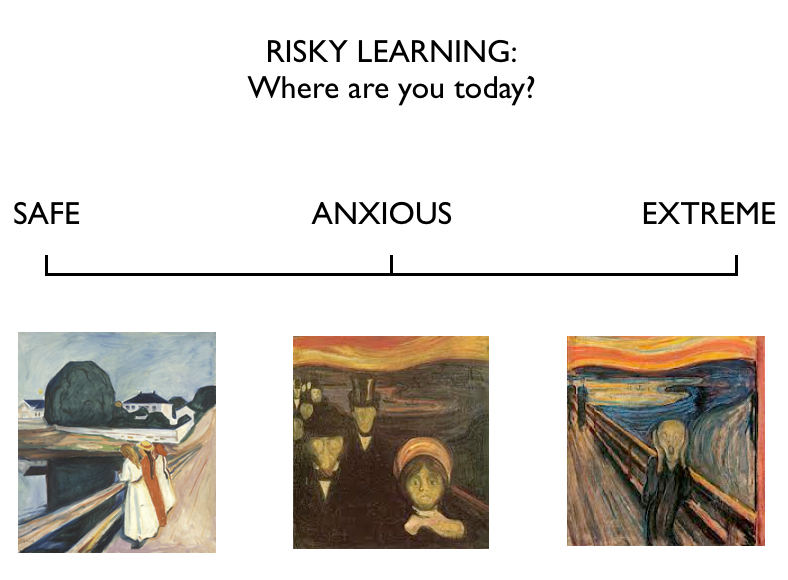
Creating a continuum line of risk-taking is a helpful way of asking learners to assess what level of risk they are either (a) prepared to take in their learning and/or (b) have taken as part of their learning. Encouraging them to discuss what we actually mean and understand when we talk about taking a risk is integral to agreeing a set of qualities of risk taking behaviours that we would, as a group, either encourage or discourage.

Screen Shot 2013-02-10 at 12.51.46

(Painting excerpts from Edvard Munch)

This also works as a handy progress measure as the group can keep a record of the level of risk they are prepared to undertake over a period of lessons and try to increase it OR see if, by developing their levels of confidence, their perception of risk is reduced.

2. What is an ACCEPTABLE mistake?

Discussing examples and scenarios where making a mistake results in such catastrophic fall-out that it cannot, under any circumstances be ‘understood’ and, thereby, forgiven is a valuable aspect of developing a culture of risk-taking. For example, we have all experienced the highly developed, some might say over-developed, sense of justice that young people often hold. When it comes to confronting and commenting on mistakes during a self or peer assessment session, agreeing the expectations and etiquette of what actually constitutes a ‘mistake’ is a crucial part of ensuring purposeful comments and feedback.

3. What are the implications of encouraging an all-embracing mistake-making culture?

Aren’t there some situations where there really is a ‘right’ answer, a correct way of doing things which basically means that the time it takes to make a mistake is wasted time?

Well, perhaps the time-element is the crucial factor here. Perhaps if we respond to a wrong answer’ or a ‘mistake’ by simply stating that it is not right this time, then we can overtly communicate that this particular mistake does not represent the end of the world and doesn’t mean that you’ll never be able to get it right or that you are rubbish at this and always will be. Instead, we can reassure that although this time, it’s not right, there’s a chance to learn from it, do it differently and get it right next time. This approach digresses slightly from the effort-focused conversations endorsed by Professor Carol Dweck in that it confronts and uses the mistake itself as the focus for the learning conversation. In this way, the inaccuracy, misconception or gap in knowledge and understanding that has lead to the mistake becomes the learning opportunity we want it to be.

4. Mistake response: What was your INTENTION?

In establishing a culture that embraces mistakes and expects risk, being both specific and overt (you would expect me to say that, I am sure) works well. Being overt about what we, as a group, understand and expect to see in an environment where learning stands proud and tall on the foundations of error, mistakes and misjudgements will enhance the quality of reflective learning conversations.

Perhaps the answer to all of this is to define mistakes as the product of intentional risk-taking i.e. ‘having a go’. This means that mistakes can simply become learnable moments. A bit (very much, actually) like all learning. This is a sort of silver-lining approach to thinking about mistakes. It also needs us to recognise that in the grand scheme of things, there is almost always something we can salvage from the embers of a ‘failed’ endeavour. If only to agree to never do it like that  again.

5. MAKE A MISTAKE MONSTER AND FEED IT!

The inspiration for this post came from a conversation I had recently where the concept of creating a ‘Mistake Monster’ or ‘Elephant of Errors’ was being discussed. A colleague had set a challenge to the students to actually design and create a personal mistake monster. During the term, they would ‘feed’ the monster with their mistakes. At the end of the term / unit / topic / lesson, the students can have a critique the mistakes they have made rather than discarding them. They would employ the pre-agreed criteria for what actually constituted a ‘mistake’. From this, there would be discussions and classifications of ‘good mistakes’ ‘helpful mistakes’ and so on, to the point where the process of learning (progress) was truly at the heart of the conversations between students and teachers.

As we discussed the possibilities of this, I started to imagine students and teachers creating their very own actual ‘Mistake Monsters’ and installing a ‘Mēlée of Mistake Monsters’ (for that is, I am sure, the collective noun of Mistake Monsters) as welcomed members of a risk-taking community of quality learning.Inevitably, this made me wonder what my own ‘Mistake Monster’ would:

(a) Need to Know and Understand

(b) Be Able to do

(c) Be Like

Mistake Monster